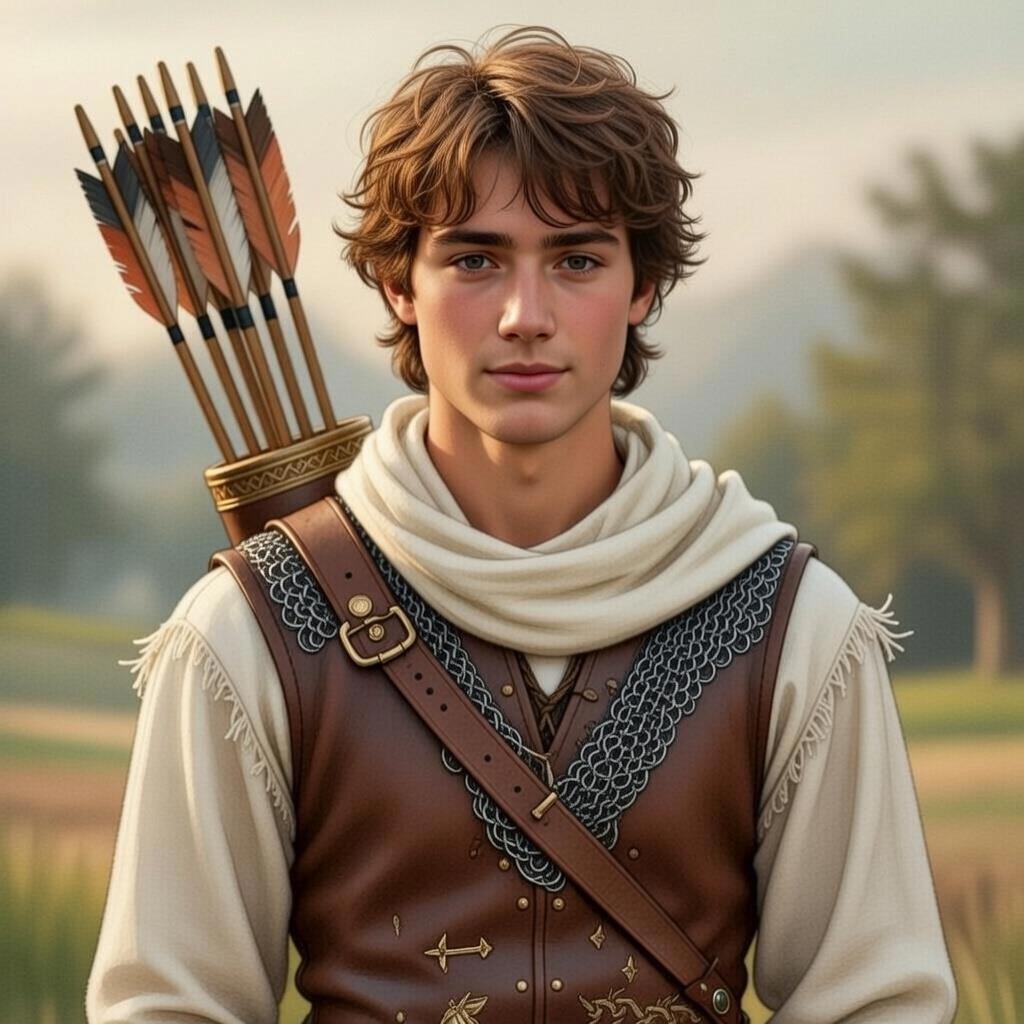
In the Land of the Narts, beyond the high mountains where eagles trace circles in the azure sky and clouds cling to snowy peaks, there lived a young man named Atsamaz. He was renowned throughout the world for his wondrous gift: whenever the young Nart took his magical golden pipe into his hands, birds fell silent, beasts grew still, and even turbulent rivers slowed their course to listen to his music.
The miraculous pipe was the only treasure left to Atsamaz by his father Atsa – a gift from the wise patron of forest beasts, Afsati. Among the Narts music was held in highest esteem; all played the fandyr, yet none attained the mastery that Atsamaz achieved. His playing awakened and enchanted Mother Nature herself. When he played the pipe, animals gathered round to hear more clearly, mountains themselves seemed ready to dance, and both sun and moon shone far more brightly.
When Atsamaz beheld Agunda, the beautiful daughter of the lord of the Black Mountain, Sainag-Aldar, he fell deeply in love with her and began to play with renewed power.
Agunda had no equal in beauty and grace: a slender, willowy figure, long brows, teeth white as ivory. Many young Narts vied in skill and strength at the foot of the Black Mountain hoping to attract the maiden’s notice, yet she paid attention to none of her numerous admirers. The girl promised to look with favor upon Atsamaz if he could win her heart through his playing on the pipe.
Atsamaz possessed the art of writing musical notation and himself skillfully composed new melodies for the pipe. Brave Nart merchants brought him paper from the Middle Kingdom. Day and night he wrote for Agunda an unprecedented melody – unmatched in beauty, strength, and tenderness. Who could count how many sleepless nights he spent, absorbed in that difficult yet sweet labor? The thought of Agunda’s favor gave him strength. And so the immense work was completed. The young man resolved to play his new melody for his beloved, the beautiful Agunda – a melody so exquisite that it would melt her proud heart.
Atsamaz did not know that he had long pleased the girl, and that only ancient custom prevented her from confessing her feelings at once. On the appointed day, awaiting her beloved, Agunda placed a chair by the balcony so as not to miss Atsamaz’s appearance, took her harp in her hands and touched its strings. Agunda’s harp was fashioned after the harp of the Nart Syrdon, except that its strings were of horsehair and its body carved from the trunk of a thousand-year-old oak. From beneath the delicate fingers of the young Nart beauty poured a clear, silvery melody, and Agunda began to sing:
Lions and timid does for a while forgot their enmity,
Afsati and the forest beasts listened to the Nart with bated breath.
Warrior-singer of legend, Atsamaz played upon the flute,
An angel descended to listen, and tears rolled from its eyes.
Twilight slowly wrapped the earth in gloom,
Yet the angel did not hasten to fly back to paradise – it grieved.
A lamb timidly pressed itself to its feet, while the moon
Bathed that little glade in mysterious light.
If only the gods had granted me such talent –
I would be like the great bard Bibo:
I would soar like a hawk into the sky with the power of thought,
Dive like a nimble dolphin to the bottom to Donbettyr.
Young Atsamaz is beautiful, his face sorrowful and stern,
Bottomless azure eyes, lips red as ruby.
He lives in harmony with the forest creatures; to them he is kin.
Since childhood they have saved the youth from hunger and misfortune…
Agunda saw Atsamaz climbing the slope of the Black Mountain that stood directly opposite her tower across the gorge. She set her harp aside and stepped out onto the balcony. At the sight of his beloved, Atsamaz’s heart fluttered like a bird caught in a snare. Trembling with emotion, he raised the pipe to his lips…
But scarcely had the first sounds of the resonant melody poured forth when the evil wind Karzuad snatched the sheet music and carried it away. Hot tears burst from the youth’s eyes onto the green grass of the BlackMountain.
“With those notes you have carried away my life!” Atsamaz cried in despair, watching the precious sheets of paper vanish into the boundless blue of the sky.
From the carved balcony of her tall tower Agunda smiled sadly:
“If you find the notes and play that very melody for me, I will give you a kerchief embroidered with golden threads. But remember – true music comes from the heart!”
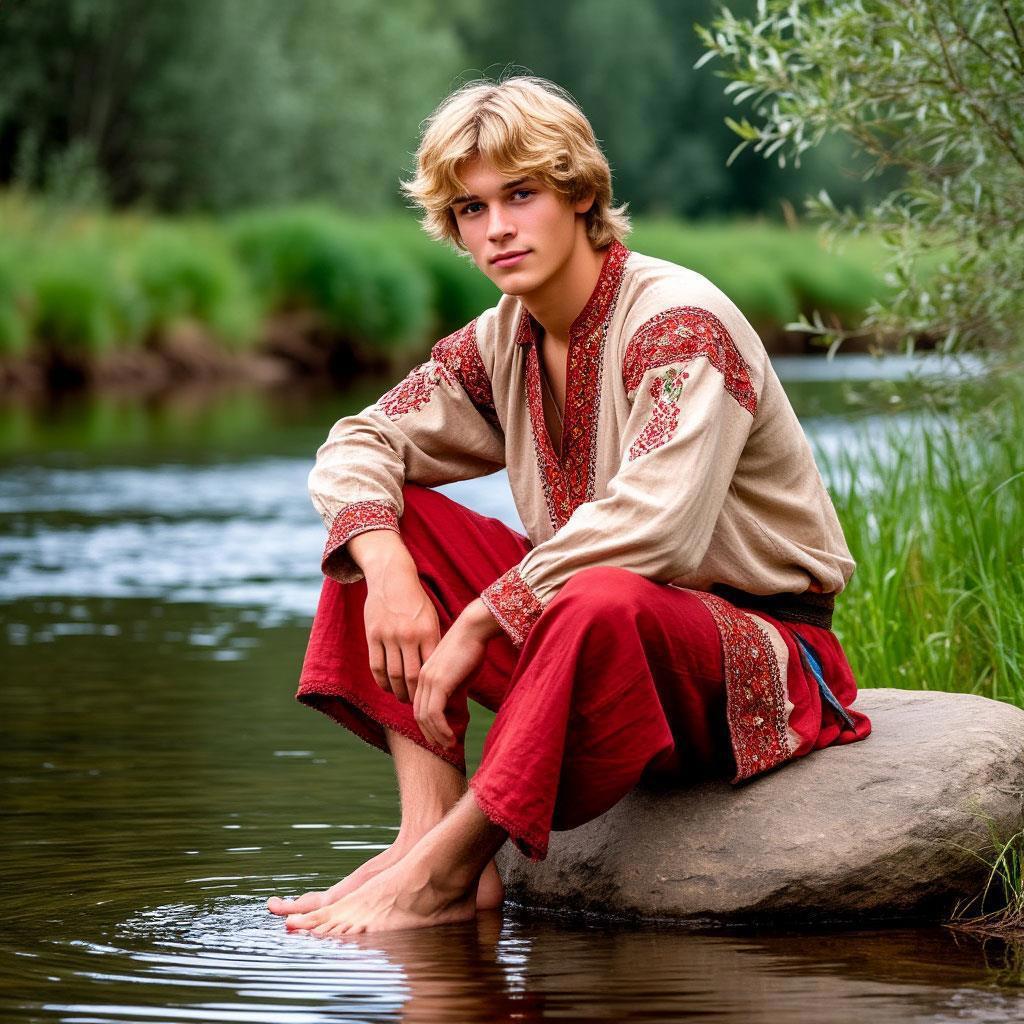
For thirty-three days Atsamaz wandered through cities and villages, along roads, fields and forests of the Land of the Narts, but nowhere did he find the lost sheets. Then the hero journeyed farther and reached the Thrice-Ninth Kingdom in the Thrice-Tenth Land. When not a crumb remained in his traveling pouch, the youth came to the Smorodin River and saw: a cheerful lad, simple yet sturdy in appearance, dressed modestly, sitting on a large stone by the water with his bare feet dipped in the stream; beside him on dry land lay samogud gusli (self-playing gusli).
“Greetings, good fellow,” Atsamaz greeted him. “Have you not seen flying notes?”
“I have, I have!” the lad laughed. “Only they weren’t flying – they were floating, wrapped in a water-lily leaf, and drifted off toward the Lord of the Seas!”
“I must find them,” said Atsamaz.
“Let us go together!” the boy proposed. “You are a musician, and I am a musician – let us travel together.”
“What is your name?”
“My father called me Ivanushka; people call me Little Fool,” he answered.
“What are you doing on the riverbank, Ivanushka?” asked Atsamaz.
“Can’t you see? Sitting by the river, catching fish with my feet.”
“And have you caught much?”
“Much or little, we shan’t go hungry,” replied the lad and stirred up the water.
Atsamaz understood that he was speaking figuratively.
“By stirring the water Ivanushka let me know he was joking about catching fish; in truth he simply decided to cool off on a hot day. But how shall we not go hungry when my pouch is empty and he has not a single fish?” thought Atsamaz.
Ivanushka put on his boots, took his self-playing gusli, and together they set off. They reached the forest; suddenly Ivanushka signaled to stop and placed a finger to his lips. Atsamaz halted and looked questioningly at his companion. The other listened, then smiled and said:
“The squirrel told her friend that in a tall tower beyond the forest lives a beauty unseen under the sun. Smoke rises from the chimney – apparently the maiden is preparing to receive guests. She will try to persuade us to stay, but if we agree, misfortune will follow.”
 Emerging from the forest, the friends indeed beheld a magnificent tower with tall shutters and doors. A maiden of blinding beauty came out to meet them. Like the clear moon amid the heavens, like the crimson dawn at morning – so did this fair maiden appear, a wonder of wonders. Her face was whiter than untrodden snow, her eyes deeper than the blue sea, her lips like ripe raspberries. Her long fair braid, like a stalk of wheat, reached the ground, interwoven with silken ribbons. Her gait was swan-like, smooth and majestic; her voice like the murmur of a spring brook. She wore a sarafan embroidered in gold and silver, and about her neck gleamed precious stones sparkling like dew in sunlight. Whoever looked upon her was enchanted; whoever heard her laughter felt his heart melt. Not a maiden, but a dream itself; not a mortal, but purity and uncreated beauty.
“Greetings, good youths! Where are you bound?” asked the maiden.
“First heat the bathhouse and feed us, then ask your questions,” answered Ivanushka.
After the bath a richly laden table awaited the travelers, and the lads ate heartily.
“So that is why Ivanushka said we would not go hungry,” Atsamaz suddenly realized.
The rest of the evening passed in questions and pleasant conversation. In the morning the fair maiden began to urge the guests to remain with her forever.

“Why hurry to distant lands, good youths, when you can find peace and delight here with me? Stay – I shall be your joy and your pleasure. We shall be eternally young, eternally happy…”
Ivanushka answered her sweet words with indignation:
“It is not fitting, fair maiden, to bar bold warriors’ path with honeyed speech! My heart has long been given to Elena the Fair – for no wonders will I trade my love, not even for eternal paradise.”
Atsamaz laid his hand on the hilt of his dagger and said:
“Nor shall I be detained, though you are more beautiful than the morning dawn. I have sworn an oath to the fair Agunda.”
The maiden’s face lost all tenderness; her voice rang clear yet cold as ice:
“Love?” – and she laughed ominously. – “It will wither like a flower beneath snow. Here is eternal love, eternal spring!”
But the brave youths turned toward the path. The maiden, who a moment before had shone like dawn, now stood with arms hanging limp – her formerly heavenly eyes glowed red like dying embers.
“For hundreds of years I awaited you… Hundreds of years I sang by the brook so that someone might hear. And you… you leave? It cannot be! I will not let you go!” she cried wrathfully after them.
Suddenly the wind howled, trees stirred and creaked as though alive. Black clouds rushed in and shadows closed around the travelers.
The maiden’s deafening voice rose above the wind and the groaning trees:
“I shall turn you into beech trees – you will stand at my threshold until time runs out like sand! Or I shall turn you into wolves – you will run behind my chariot yet never catch it!”
Yet neither hero faltered; they only gripped each other tightly so the furious wind would not tear them apart.
“You shall answer for this, villainess!”
At those words the maiden seemed scorched; wearily she sank onto the threshold. Everything grew still, and the youths heard her sorrowful voice:
“Very well… I see you cannot be broken. There is no power stronger than your foolishness… that is, your love and friendship. One cannot force affection. Go in peace…”
She waved her hand – and the path before the youths cleared, opening the way. Suddenly the forest glade flared with pale light. The maiden, who moments before had raged, froze – her body began to grow transparent like morning mist.
The girl cried out in fear:
“What is happening to me? I… I remember!”
The fair maiden fell to her knees, her voice trembling:
“They abandoned me here – my betrothed and my brother. They cursed me for pride… They said: ‘You shall be the ruin of faithless souls, and only the fidelity of others will set you free’…”
The travelers turned and saw: the marvelous tower vanished, the maiden’s regal attire turned into a simple linen peasant shirt, and instead of a diadem a modest wreath of field flowers appeared in her hair. Yet her face remained just as beautiful, and her eyes once again became blue.
Ivanushka asked, cautiously approaching:
“So you are not a villainess…”
Atsamaz rushed to the girl, helping her to rise, and finished for his friend:
“…but a victim!”
The maiden burst into tears:
“For three hundred years I ruined travelers, and none withstood my beauty. And you… you are the first who chose fidelity to your beloved. But your love and fidelity have broken my chains, and now I am free. I am granted the happiness of beginning a new life – without the darkness of cold pride.”
A light breeze carried away the last remnants of the enchantment – now she was simply a girl, pale and weary, yet free.
Ivanushka said joyfully to Atsamaz:
“Look – we helped someone while hurrying after your loss!
Atsamaz nodded to his friend, picked up the fallen colorful ribbon of the maiden and offered it to her:
“Keep it as a remembrance. Let it remind you of our meeting and of the terrible three-hundred-year lesson. Return home and be happy… What is your name?”
For the first time in long years an honest smile lit the maiden’s face:
“Matryona is my name. My home is in Times Past; I go home – to each his own time.” With these words she finally dissolved into the air like thin smoke; the colorful ribbon fell to the ground, wriggled like a nimble snake into an inconspicuous crack, and the crack closed as though it had never existed.
Thus Atsamaz became fully convinced that Ivanushka was in truth no fool at all. He understood the speech of beasts and birds and saw what others could not. And people… people hate those who are better and wiser than themselves and spread all kinds of gossip. Atsamaz too sometimes found life difficult in the Land of the Narts.
The road was long, but in conversation time flew swiftly. The friends grew very weary. Darkness began to fall and they had not yet reached even the border. The lads chose a small glade and decided to make camp. They supped unhurriedly on wild fruits gathered along the way, seasoning the meager fare with talk, and began to settle for the night. Suddenly a loud rustling sounded very close. Atsamaz seized his bow and managed to nock an arrow. From the bushes appeared a large gray wolf.
“Stop, Atsamaz, do not shoot!” cried Ivanushka. “This is my friend. Ah, you, little Gray One!”
“You’re the little gray one,” the wolf growled good-naturedly. From the wolf’s hide stepped a youth in a strict dark-green caftan and green velvet cloak.
Atsamaz stared wide-eyed.
“Why did you set off without warning anyone, my friend? Without food, without drink,” the former wolf said reproachfully and drew from his breast a small pouch beautifully embroidered with patterns.
Ivanushka smiled at his companion’s astonishment.
“Allow me to introduce: Ivan-Tsarevich, my friend. Son of our Tsar Berendey. An evil witch turned him into a wolf, yet at sunset he may assume his true form. And this is Atsamaz from the Land of the Narts. He seeks the notes of his new melody, stolen by the wicked wind Karzuad.”
“Forgive me, Tsarevich – I did not recognize you in wolf shape.”
“It happens,” Ivan smiled and drew from the pouch a self-filling tablecloth.
Atsamaz and Ivan-Tsarevich shook hands in greeting, kindled a fire, and all three sat down to supper.
He asked his friends about life in the Thrice-Tenth Land, while he himself told them of the Land of the Narts. Talking thus, they did not notice how they fell asleep beside the fire.
The sun was high when Ivanushka and Atsamaz awoke. Ivan-Tsarevich was no longer beside them. With the first rays of sun he had again become a wolf and departed so as not to embarrass his friends. Having breakfasted on the remnants of supper, the two friends continued their journey. They left the crumbs for the forest birds, and Ivanushka tucked the last crust of bread into his bosom.
Long they journeyed, short they journeyed, until they reached the Middle Kingdom. Exhausted and quite hungry, the friends decided to eat Ivanushka’s last crust. But suddenly they saw an old beggar in filthy rags approaching.
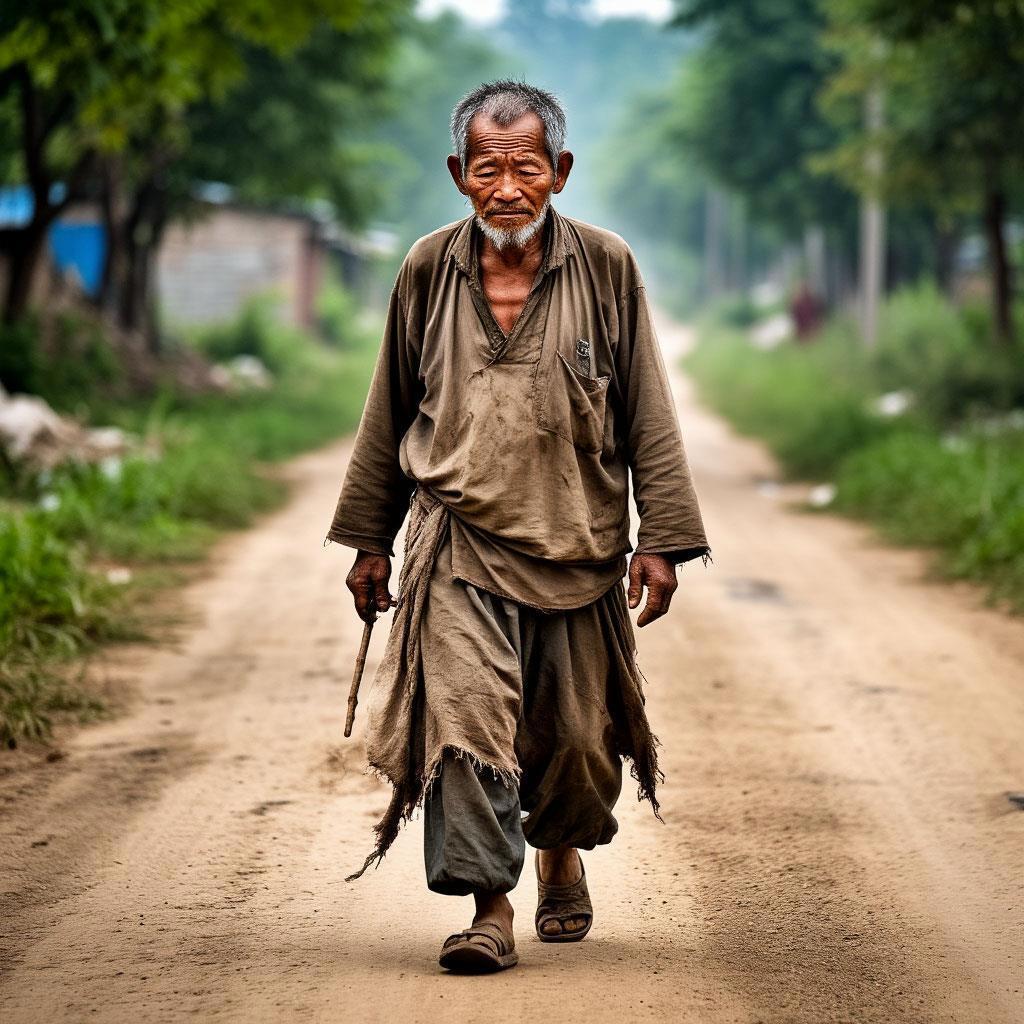
“Take pity on me, good youths, I have eaten nothing for two days – do not let an old grandfather die of hunger!” he moaned piteously.
Without hesitation Ivanushka drew the last crust from his bosom and handed it to the beggar.
“Ha-ha-ha! Hee-hee-hee! Now you have no food left!” the “old man” suddenly cackled and in an instant turned into a little red fox with cunning cherry-like eyes.
Yet Ivanushka did not grow angry. He laughed as though at a good joke, while Atsamaz raised the pipe to his lips and played his favorite “Song of Morning Dew.” The melody was so tender, so sweet, so kind and caressing that the little fox froze, unable to comprehend what was happening to him.
For a time his body remained motionless, but within his soul a true storm raged – like boiling water, a mighty hurricane, a sandstorm, a volcanic eruption, a powerful tempest. All that was evil burned away in the flame of the unknown power of the incomparable beauty of Atsamaz’s magical pipe melody, and only kindness remained in the fox’s soul.
At last the little fox regained the ability to move. Hot tears stood in his eyes – tears of happiness and joy.
“My name is Huli-jing, I am a fox-boy,” he said. “And you?”
“This is my friend Atsamaz from the Land of the Narts,” answered Ivanushka, “and I am Ivanushka the Little Fool.”
“Not a fool at all!” exclaimed Atsamaz.
“I too see no fool here,” said the fox-boy, closing his eyes and regarding Ivanushka from different levels of existence.
“But people…” Ivanushka tried to object.
“Oh, these little humans!” Huli-jing could not hide his feelings. “If only you knew how I enjoyed mocking those fools! I was both an evil and a good shape-shifting spirit. But now I have become only good. I beg you, Atsamaz, do not play that melody again, or everyone will become kind and life will grow boring.”
“Alas, there are far too many evil people; one melody cannot embrace and make kind even a small portion of the living. Therefore I cannot grant your request, wise little fox, but I ask you to grant mine: assume your true form so that everything between us may be honest.”
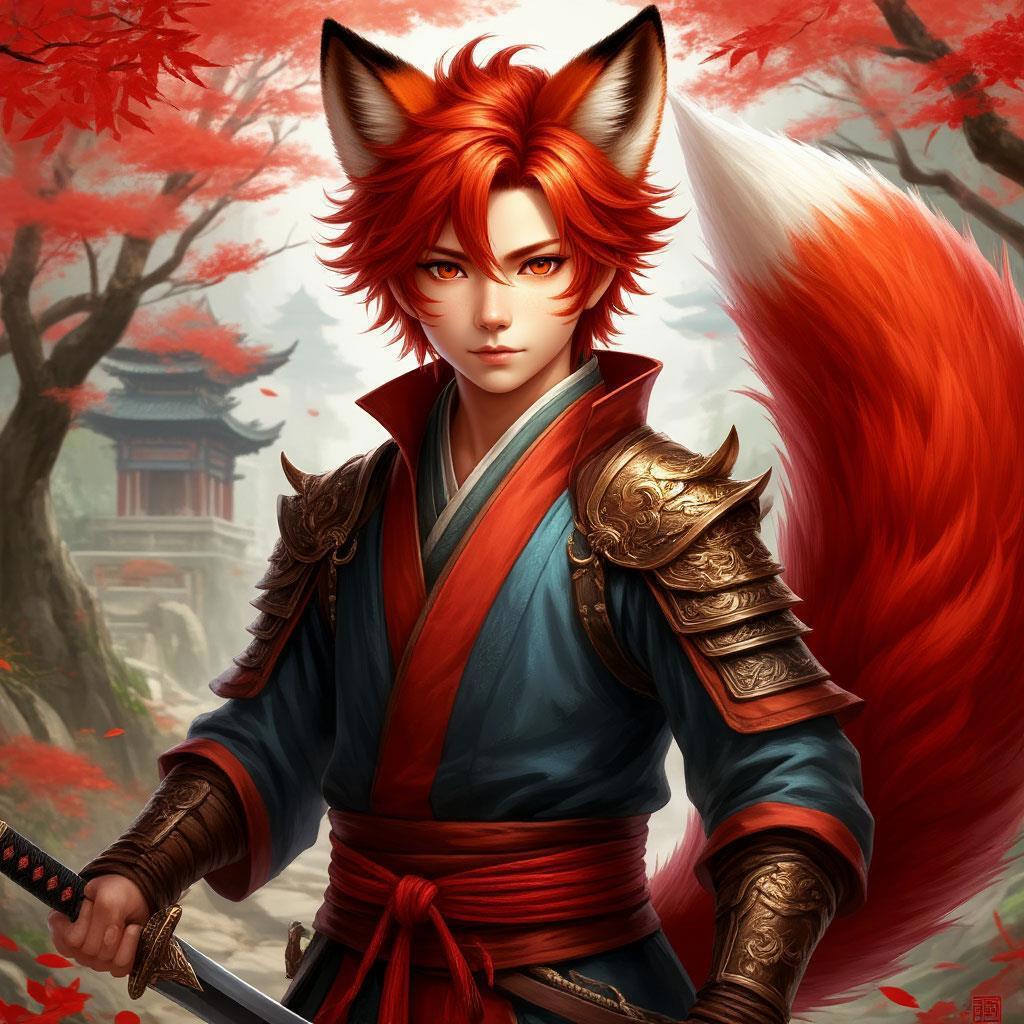
Huli-jing hesitated a moment, then transformed into a valiant youth with red hair, slanted eyes, beautiful fox ears, and a fluffy red tail tipped with white. He wore simple yet elegant garments of a warrior-hermit; at his belt hung a straight Chinese jian sword.
Seeing that his companions were weary and hungry, the red-haired youth waved his hand and a small table appeared before them with tea utensils.
The air carried the fragrance of plum blossoms and fresh bamboo. With ceremonial precision Huli-jing arranged the objects on a mat. He kindled charcoal in a miniature longhuo stove (“dragon’s breath”) and said:
“Sit, friends – tea does not tolerate haste. As my teacher said, the water should fear your respect.”
While the water heated, the fox placed three bowls on the table: a jade one for Atsamaz, symbol of purity; a golden one for Ivanushka, its exterior covered with a rough layer of ceramic – a hint at the wisdom the youth modestly concealed beneath simplicity; and for himself a dark-blue Longquan bowl with living, iridescent glaze resembling fox eyes.
When the water boiled, Huli-jing took a bamboo ladle, poured boiling water into the empty bowls and immediately emptied it onto the stones. Steam rose and vanished into the air, taking the shape of a running fox.
Ivanushka and Atsamaz exchanged glances and smiled at the fox. Pleased with the effect, Huli-jing drew from a silk pouch tea buds resembling tiny silver dragon claws and explained:
“This is Bai Hao Yin Zhen – silver needles with white down. Maidens in white gloves gather it so as not to defile the sprout.”
He poured water over the leaves and immediately poured it onto the ground:
“First we must awaken the tea. Then its aroma will be like honey and newly mown grass.”
Atsamaz inhaled and said:
“Like… after rain in our mountains, in the Land of the Narts…”
Ivanushka said:
“And with you my soul feels as light as at home when we brothers drink tea from the samovar beneath the white birch in our garden in the Thrice-Ninth Kingdom.”
Huli-jing nodded to his friends and said:
“The spirit of this tea is qing – purity. It hates falsehood. If one of you had lied just now, the water would have clouded.”
He poured the second infusion; the bowls filled with golden liquor. Raising his own with both hands he said quietly:
“Tea is a dialogue between Earth and Heaven. Drink slowly: the first sip is the past, the second is the present, the third is that which has not yet come to pass.”
The friends pondered his words and drank their bowls in silence. The wind stirred the leaves of the trees; somewhere far away a single bell chimed softly.
When the tea ceremony ended, Huli-jing turned the lid of the teapot sideways and said:
“Now you are guests of the Celestial Empire. When it is hard, remember this taste.” With these words he poured the last of the tea onto the ground as an offering to the spirits. The little table vanished as though it had never been.
The sacred Chinese ritual had given new strength to the weary travelers, as though they had satisfied their hunger with a rich feast.
“Friends,” Huli-jing said with a smile, “I have already asked the clouds where your notes are. They are with the dragon Di-Lun. He lives in a cave beyond the Burning Mountain and collects everything beautiful because he himself has lost the joy of living…”
“But how did they come to him?” Atsamaz wondered.
“The clouds say that after stealing the notes the evil wind Karzuad rushed with terrible force, struck Mount Sana without noticing, and dropped what he carried. The notes fell into the river, wrapped themselves in a water-lily leaf and floated to the Sea King. The Sea King presented them as a gift to the dragon Di-Lun, ruler of rivers, springs and seas.”
Atsamaz looked at Ivanushka in amazement, remembering their conversation by the river in the Thrice-Ninth Kingdom.
The path to the dragon’s cave was not short. When the friends grew tired they halted for rest. In those moments Atsamaz played his magical pipe, Ivanushka his self-playing gusli, and Huli-jing skillfully played the guqin – that ancient Chinese seven-string plucked instrument. It symbolizes culture, philosophy, and the refined luxury of flourishing greatness.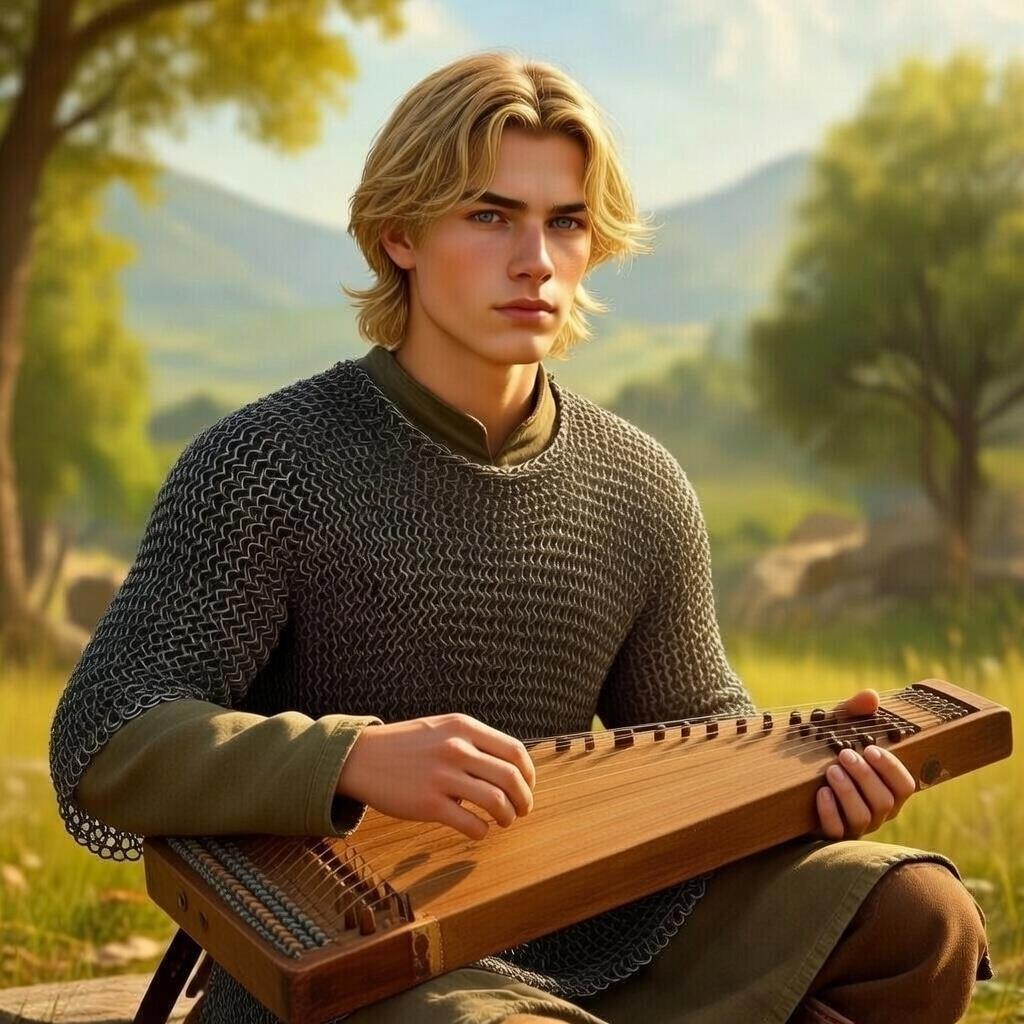
When Ivanushka played the gusli – like morning dew melting under the sun’s rays, so did the golden strings drive weariness from the souls of the three friends; darkened eyes brightened and pure clarity settled in the mind.
When Atsamaz played the pipe – the melody flowed clear as spring water over pebbles; strength filled their bodies and youthful daring awakened.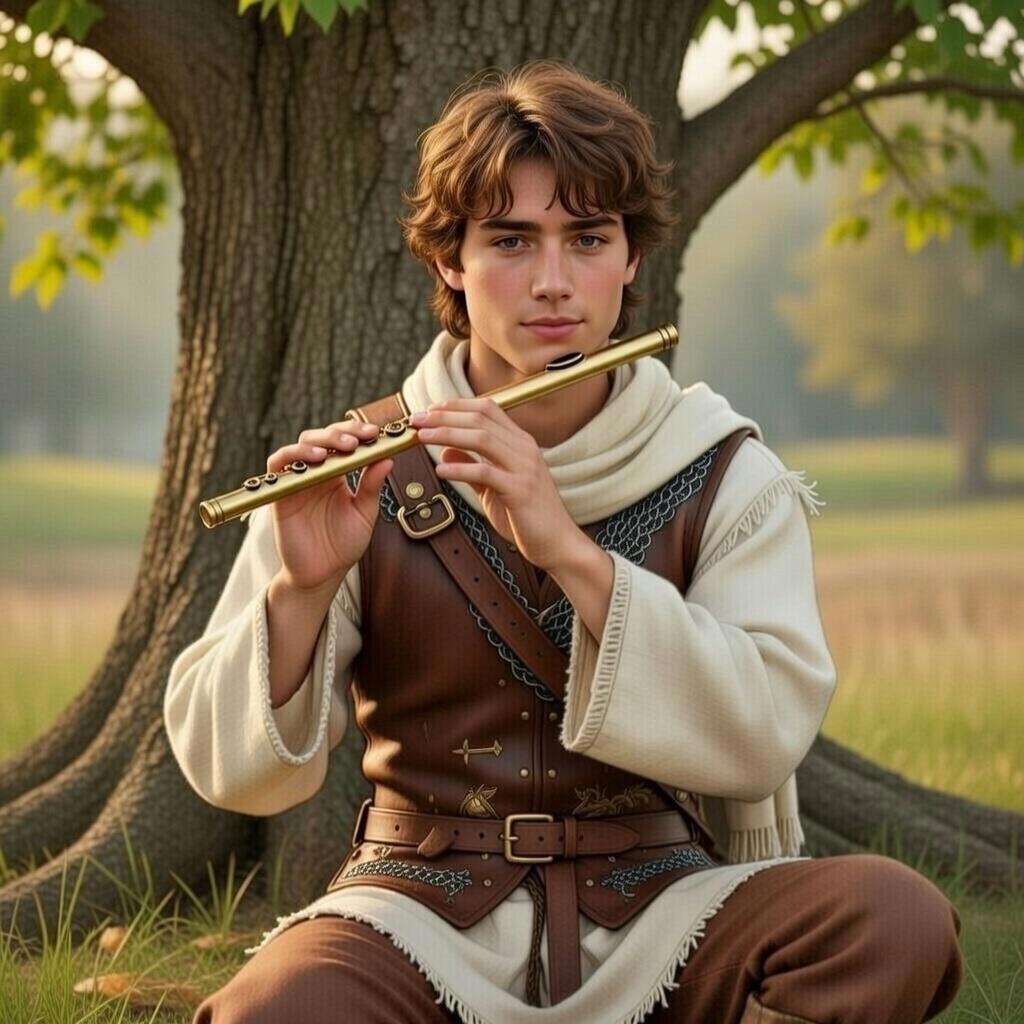
When Huli-jing played the guqin – ancient wisdom itself seemed to speak with the friends; they began better to understand the essence of things, the eternal and the passing.
The friends loved how beautifully and harmoniously their instruments sounded together. Once Huli-jing remarked:
“Music is the harmony of Heaven and Earth. When qin and se sound in harmony – great unity reigns beneath the sky.”
In the Celestial Empire it was held that music expresses harmony and concord, and the duet of qin and se is the model of the harmonious connection of all elements of the cosmos, expressed through the sounding of musical instruments.
A tale is soon told, but the deed is long in the doing. At last the peak of the Burning Mountain appeared in the distance. The travelers approached the lair of the Stone Lion Pi Xiu. The Stone Lion looked most ferocious: huge round head, wide-open mouth baring sharp teeth, eyes blazing with bright flame. His body was powerful, short limbs tipped with sharp mighty claws, tail curled and bushy. He was one of the five great beasts of antiquity, revered in the Divine Realm as a god of good fortune. His chief duty was to guard the treasures and valuables of rulers and to drive away evil spirits. Pi Xiu barred the travelers’ path, enormous and terrifying.
“Who goes there?” he thundered in an authoritative voice and, without waiting for an answer or warning that a contest of questions and answers was beginning, posed the first riddle:
“Ivanushka, answer: what is higher – strength or wisdom?”
“It does not matter,” Ivanushka replied without hesitation. “For above all things in the world stand goodness and love!”
The Lion looked at Ivanushka; his stone brows drew together, then he growled:
“Atsamaz, what is higher – pride or humility?”
“Pride gives strength to fight an enemy, yet in one strong in soul and body goodness begets mercy toward a defeated foe and humility before the one you love,” said the youth.
Pi Xiu frowned, yet found no objection and turned to the fox-youth:
“Huli-jing, what is higher – li or virtue?”
The fox-youth paused, weighing each word, then began:
“Li is the heart of Chinese philosophy. Propriety, etiquette, ethics, ritual, ceremony. Li is correct behavior and the world-view foundations from which correct behavior flows. In the most ancient chronicles ‘li’ means rites that overcome political conflicts and reflect the unity of the world – temple and palace ceremonies, forms of relation among different social strata. But a man who observes both li and virtue without love in his heart merely deceives himself. Therefore I too say that love and goodness stand higher than both li and virtue.”
At these words even the stone fur of Pi Xiu stirred. It stirred only at correct answers – which, however, he seldom heard. And wise as well as correct answers – the Stone Lion could not even recall hearing such. He sat back on his haunches and pondered.
“For thousands of years I have heard nothing wiser,” the Lion declared, and let the travelers pass.
“Beware the River of Oblivion!” he called after them when they had not gone far.
It appeared half a day later. The water of the River of Oblivion was black as pitch. Even the sun was not reflected in it. The channel was not wide, not deep, yet whatever the water touched forgot who it was, where it was going, and why.
The three friends stood on the bank, gazing at its black surface. Nowhere in the visible expanse was there a single bridge or boat. Atsamaz’s magical pipe could halt the flow of any river, even turn it backward, yet it could not deprive the River of Oblivion of its deadly magical power.
“Why do you stand there?” said the River of Oblivion. “I am not wide, not deep. It will not be hard to cross me. But the moment my water touches you, you will forget everything you ever knew. Everything living that my water touches forgets itself, forgets where and why it is going.”
The friends stood frowning in thought, not looking at one another. The obstacle seemed insurmountable, and to return empty-handed was unbearable. At last one of them said:
“Lads, it would be good to have something to eat.”
Before the travelers appeared the familiar Chinese table, but this time laden with all kinds of food. As a true son of the Celestial Empire, Huli-jing loved philosophy. Nor were his new friends strangers to it. The youths sat around the table and gave themselves to philosophical conversation over the abundant fare.
They were, however, very moderate in eating. The table still groaned under the dishes when the travelers had satisfied their hunger. Yet they did not hurry to rise, continuing their talk.
Suddenly Ivanushka jumped up and looked thoughtfully at his friends. He seized Huli-jing’s ritual bamboo ladle from the table and scooped black water from the River of Oblivion.
“River, you say that everything living will forget everything it knew if your water touches it?”
“Quite correct – everything living will forget everything it knew if my water touches it.”
“River, you are speaking, therefore you are living?” – and before an answer could come, Ivanushka poured the river’s own black water back into the River of Oblivion from the ladle.
There was no explosion, no earthquake – only that instantly, the river lost its color and became completely transparent. Its bed truly was shallow – it had spoken the truth.
“River of Oblivion, what will happen if we ford you?”
“Good youth, why do you call me the River of Oblivion? I am an ordinary clear cold river flowing from mountain glaciers to the Great Ocean; when you ford me you will merely wet your feet.”
Atsamaz and Huli-jing rushed to praise and embrace Ivanushka, who only smiled shyly. The fox-youth quickly cleared the table, and without losing time the friends waded across what had been the River of Oblivion. It had forgotten that it must take memory and knowledge from all living things, erasing their personality, and had become an ordinary peaceful river.
And the friends walked and walked onward. At last – the Burning Mountain. The lads expected to see the dragon at the cave entrance, but no one was there. So they decided to enter.
Deep in the cave, on a heap of treasures, lay Di-Lun – enormous, mighty, yet somehow… sorrowful. His scales had dulled, cobwebs clung to his wings here and there.
“Why have you come?” he murmured with powerless reproach. “To take away the last thing I have?”
“We have come to reclaim the notes,” said Atsamaz. “But we can also help if you will tell us why you are so sad.”
And the dragon told his story. Once he had been lord of rivers, seas and oceans, but, having grown sated with the beauty of blue heavenly expanses, watery surfaces and underwater realms, he lost his taste for life.
“I lost the divine gift that allows one to feel the beautiful. Without it I forgot how children’s laughter sounds, how rain smells… I began to collect beauty, but it is dead without a fresh gaze, and so I lost the joy of living!” the dragon said sadly and closed his eyes.
“What then shall we do?” the friends exclaimed.
Atsamaz tried to heal the dragon’s melancholy with parables from Nart tales, Ivanushka with Russian byliny, Huli-jing with abundant quotations from the treatises of Confucius and the Chinese historical epic – Luo Guanzhong’s Romance of the Three Kingdoms.
Yet nothing helped the poor dragon. He felt gratitude toward the three friends who so earnestly wished to heal him, gave them the sought-after notes and let them depart in peace, but they did not hurry to leave. Each in farewell offered the sorrowful dragon his most cherished melody. Ivanushka gently touched the silver strings of his priceless gusli, the fox-youth drew enchanting sounds from his beloved guqin, and Atsamaz played on the magical pipe his new melody – for all the written notes were now in his hands!
When the last sounds melted in the damp air of the cave, a true miracle occurred – the dragon’s eyes blazed with bright light, his scales shone with fresh patterns, his wings unfurled and regained their former power; seized with immense joy he sprang to his mighty legs.
“Thank you, travelers… Now I have regained the joy of living!” he boomed in a thunderous voice, left the gloomy cave, soared into the air and described a huge circle across the boundless blue sky. The lads ran out after him and cheered with joyful shouts. Together with the joy of living Di-Lun regained his former strength and once more became lord of rivers, seas and oceans. Returning, the dragon touched with a claw the stack of sheets of Atsamaz’s latest melody; the paper sheets turned to gold and the notation lines to purest silver.
He did this not to impress his new friends:
“A long journey still awaits you,” he explained. “Rain might wet the paper and destroy the entire melody…”
Now, after so many adventures, the friends faced the road home. Huli-jing accompanied them to the border of the Thrice-NinthKingdom and, though the friends called him to come along, he cited important affairs and remained in his homeland. When the time came to part, the fox-youth took out his magical guqin and played them a farewell piece – the sorrowful melody “Song of the Autumn Leaf.”
Ivanushka and Atsamaz felt sad that they must part from their friend. Atsamaz wanted to say how much he would miss Huli-jing in the Land of the Narts, but instead he said:
“Your melody is very sad, yet it sounds magnificent. I shall never forget it.”
“And I shall carry it in my heart to the Thrice-Ninth Kingdom and listen to it at home whenever I wish,” said Ivanushka. “It is great music.”
“Thank you, my friends,” Huli-jing answered modestly. “Music is the harmony of Heaven and Earth, yet the greatest music is heard in silence…”
Then the fox-youth drew from his breast a round jade amulet on a red cord and offered it to Atsamaz. Atsamaz took the amulet and examined it carefully. The stone was warm, almost alive. On one side coiled a dragon holding a pearl in its jaws; on the other bloomed a peach branch bearing three fruits. In the rays of the noonday sun it glowed with deep green light, as though a lake shimmered beneath it.
“Jade remembers everything,” the fox-youth smiled, though his eyes remained serious. “Even what its owner wishes to forget.” He ran a finger along a crack on the dragon’s paw. “See? This is from a mistake I made three hundred years ago when I was evil. And this branch…” he touched the other side, “…flowered when I first heard your melody. The peach symbolizes healing and longevity. The dragon will protect you from evil forces and warn you of mistakes.”
Ivanushka winked at his friends and asked gaily:
“So if Atsamaz now makes a mistake while playing the pipe and plays a false note, another crack will appear on the amulet?”
“No,” Huli-jing snorted, “but if your friend forgets why he is playing – the amulet will grow cold as ice.”
He looked at the Nart and said:
“The heart of the pipe and the spirit of the sword have become one in you.”
Then he sharply closed Atsamaz’s hand around the amulet and said with feeling:
“Atsamaz, do not let it freeze!”
After that the fox-youth looked thoughtfully at Ivanushka.
“And for you, my wise friend, I have prepared a special gift. You understand the language of beasts and birds.”
Ivanushka wanted to object, but the youth forestall him:
“Yes, I know. Except the language of foxes.”
Huli-jing lightly clapped Ivanushka on the shoulder and said:
“Now you understand the fox language too. Speak with any fox – it will answer.”
The friends fell silent. Each thought that only a few days earlier they had not even known of each other’s existence, lived in different lands, had different characters – yet now it was so hard to part. Expressing their common feeling, and as though explaining it, Huli-jing said:
“Noble men strive for harmony, not uniformity.”
Far off came the cry of cranes.
“I will return,” said Atsamaz.
“We shall meet again,” said Ivanushka, and the friends continued on their way.
A story is easily told, but time passes far more slowly, as they say in the Middle Kingdom. In the Thrice-Ninth Kingdom Ivanushka and Atsamaz were met by the Gray Wolf, who at sunset again became Ivan-Tsarevich. He spread the familiar self-filling tablecloth and feasted his friends handsomely. They, interrupting each other, told him of their wondrous adventures in the FloweringKingdom, of Huli-jing, the Stone Lion, the River of Oblivion, the kind dragon, and the sorrow of parting…
In the morning the lads set off farther, toward the capital, toward the palace. Ivan-Tsarevich had not seen his kin for a long time and missed them greatly.
There they met him with immense joy. Tsar Berendey and the Tsaritsa his mother, his brothers and sisters Fyodor, Vasily, Marya, Olga and Anna rushed to embrace and kiss their son and brother.
They welcomed Ivanushka and Atsamaz as kin. They also invited the Tsarevich Vasily’s betrothed – Vasilisa the Wise.
All regretted that they could see Ivan in human form only from sunset to sunrise.
The next day Atsamaz persuaded his friends to visit him in the Land of the Narts. The Tsar and Tsaritsa reluctantly let their son go, not forgetting to include gifts for Uryzmag and Shatana. And Vasilisa offered the lads to continue the journey on her flying carpet.
Atsamaz wondered how they could all fit on such a small rug. Yet when the time came to fly, the carpet’s surface grew large enough for the travelers to sit comfortably. The carpet rose high; Atsamaz and Ivanushka looked down and gasped: people, carriages, houses, the palace itself and the fields became tiny, quite minute. Ivan-Tsarevich was not surprised – this was not his first flight. True, flying in wolf shape was a first for him. It caused certain inconveniences, but not so great as to prevent flying. Having risen just above the treetops, the carpet gathered speed. The novices at first feared they might be blown off, but the carpet’s magic damped the headwind for its riders; whenever anyone approached the edge, that edge rose to protect against falling.
That flight was a true wonder of wonders. Flying over forests – the carpet glides, fir trees caress its fringe with their tips and smile; over rivers – the carpet flows like morning mist, fish leap from the water flashing silver sides; over fields – the carpet traces figures in the air, so the riders nearly tumble off, while the wheat stalks whisper after it: “Look at that fine fellow!”
Three marvels occurred along the way. They met a грозовая cloud. The carpet soared – higher than the cloud itself, where the sun was playing! They overtook a wedge of cranes. The carpet passed them so dashingly that the cranes nearly lost their formation! They flew toward the clear moon. The moon gave Ivanushka a silver ray: “Take it, lad, keep it for luck!”
They flew a day or two, no more. Just at sunset the carpet descended in the Land of the Narts at the door of the wise Shatana, Atsamaz’s foster mother; it waited until the travelers dismounted and took their gifts, then shrank to ordinary size, rolled itself up and fell still.
From that time onward Ivanushka would say, remembering his first flight: “I have seen, brothers, how Mother Earth embraces Father Sky! Seek not wonders beyond the seas – they are beneath our feet and above our heads!”
The wise woman Shatana had known in advance of the return of her beloved foster son Atsamaz with his friends; even before their arrival she ordered the bathhouse heated, met the travelers herself on the threshold, and in the upper room awaited a richly laid table.
Until midnight the guests told of their adventures; when bedtime came, Ivan-Tsarevich asked the wise Shatana:
“Our noble hostess, do not order the outer door locked for the night.”
Shatana looked questioningly at the youth. He hesitated and, reluctantly, told her of the evil witch’s curse.
“…therefore at the first rays of sun I shall be forced to leave your hospitable house and go into the forest,” the Tsarevich finished his sad tale.
Shatana listened patiently to the end, then looked straight into his eyes and said:
“There is no need: the moment I saw you I removed the evil witch’s spell and deprived her of power. Now she is simply a poor, lonely, helpless old woman. Forgive her. She will do no more harm to anyone.”
When dawn came, the three friends left the house and climbed to the summit of the Black Mountain. Such a powerful feeling seized Atsamaz that even the jade amulet of Huli-jing on his chest began to pulse with emotion. Standing opposite the balcony of the beautiful Agunda, Atsamaz sang:
The vagabond wind runs before me like a light doe,
Unwilling to carry my sorrow away with it.
Time of anxiety gathers again like a timid swallow –
How to live without you, my heart does not know.
Grant me your gaze, do not be stingy,
Gently, sovereign of sweet dreams,
Touch my passionate heart with love –
Let it blossom with rosebuds!
A golden star flies across the dark sky,
The sighs of an enamored heart are indifferent to the star.
A radiant, dear gaze – that is what a poet needs;
A world without love is sorrowful and gloomy for him.
Grant me your sunny, gentle gaze,
See how it will leap in my stern breast,
With the vow of living, endless spring –
A ray of your secret love…
Then, with all inspiration and mighty tender passion, he played his cherished melody – the one he had sought through great trials and for which he had gained true friends.
And what happened next – of course you already know without me from the Ossetian Nart epic.
2025
All images were generated by the “Shedevrum” neural network in accordance with descriptions found in folkloric sources; their public use has been согласован with Yandex.
 ТЕЛЕГРАМ
Канал с обзорами, анонсами новинок и книжными подборками
 Книжный Вестник
Бот для удобного поиска книг (если не нашлось на сайте)
 Поиск книг
Свежие любовные романы в удобных форматах
 Любовные романы
Детективы и триллеры, все новинки
 Детективы
Фантастика и фэнтези, все новинки
 Фантастика
Отборные классические книги
 Классика
 ВКОНТАКТЕ
Библиотека с любовными романами, которая наверняка придётся по вкусу женской части аудитории
Любовные романы
Библиотека с фантастикой и фэнтези, а также смежных жанров
Фантастика
Самые популярные книги в формате фб2
Топ фб2
книги