Prologue
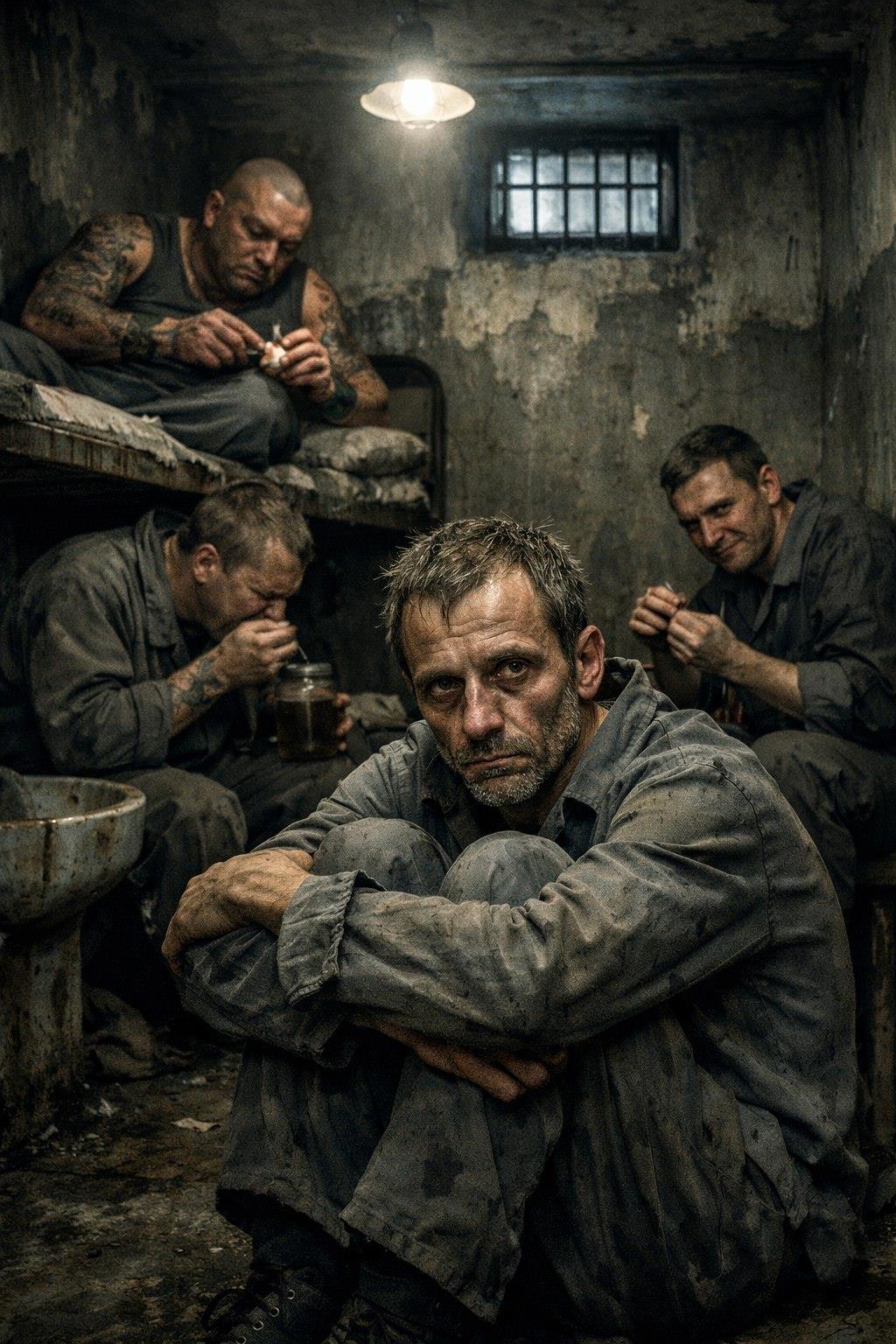
The cell smells of people.
It's not just a smell — it's the quintessence of everything Yevgeny had always despised. Stale foot wraps, cheap tobacco, chlorine that hadn't been used here since perestroika times, and the sour sweat of bodies that don't know what a daily shower means. Mixed with this is something else, something bleak and hopeless — the smell of a place where time has stopped.
Yevgeny sits crouched by the wall, arms wrapped around his knees. Third day. Or fourth? He's lost count. The window under the ceiling is barred, letting in a strip of grey light that crawls along the wall, bringing neither warmth nor hope.
Three cellmates.
On the bunk lounges the "boss" — a pumped-up guy around forty, with finger tattoos, lazily cutting paper with a lighter. He's in charge here, and everyone knows it. On the lower bunk, two younger ones: one constantly coughing and spitting into a jar, the other — shifty-eyed, fidgety — filing his nails on the edge of a stool. They don't even have names for Yevgeny. Only functions: The Boss, The Wreck, and The Snitch.
Yevgeny looks at them and feels a familiar wave — disgust. It overwhelms him whenever he encounters something primitive. People who live by instinct. Who can't see beauty in the texture of leather, can't appreciate a perfect stitch, can't understand that one can seek perfection, not just eat, sleep, and copulate.
"Brainless," he thinks. "Animals. They don't even understand that I... that I'm different."
"What you staring at, tanner?" the boss drawls lazily, catching his gaze. "Sit still and don't twitch. Or I'll turn you into leather real quick."
The shifty one giggles. The wreck doesn't even lift his head.
Yevgeny turns to the wall. He wants to sink through the floor, disappear. Or, on the contrary, jump up and scream that they're all... but he can't scream. He's silent, teeth clenched. A pulse throbs in his temple: "How? How did I get here? Where did I go wrong?"
He starts pacing.
Three steps there, three steps back. It's the only thing that calms him a little. Monotonous movement, like in the workshop along the shelves. A rhythm that always helped him think. But here it irritates.
"Pacing and pacing," the boss drawls. "Sit down, I said!" He half-rises, and Yevgeny freezes.
He sits on the edge of his bunk. Curls into a ball. Silence, only coughing and the scrape of the lighter on paper.
Outside, it gets dark. The bulb under the ceiling dimly lights the cell. Yevgeny lies on his back, staring at the ceiling. Thoughts spin, bump into each other like blind kittens.
The workshop... The smell of leather... The granite slab... Mother, her shouts: "Again with your chemicals!"... Anna... her eyes, wide, delighted, when she looked at his stitches...
He squeezes his eyelids shut. Her face appears before him. How she came in then... in her biker jacket, with a voice recorder... "Hello, I'm a journalist, I want to write about artisans..."
Yevgeny shudders. Back then, he almost believed she was the one. The connoisseur. Who would understand. Who would see.
And she turned out to be...
Who did she turn out to be? He still doesn't know. A savior? A demon? A woman who just wanted the truth? Or someone searching for something of her own, something lost, in him?
But because of her, or thanks to her, he's here.
He falls asleep towards morning. A heavy sleep, without dreams, like falling into a black pit.
The bolt clangs. Yevgeny jumps up, not understanding where he is. His heart pounds in his throat.
"Zamyatin!" the guard yells. "Get out, with your things!"
His heart sinks. Transfer? Trial? The cellmates watch him go — the boss lazily spits on the floor, the shifty one giggles, the wreck turns to the wall.
But he's not led to transfer, but to the visitation room. The guard, more quietly, almost friendly, says in his ear:
"A visitor for you. Local big shot, journalist. Blogger, damn it. They say she has almost a million followers. The higher-ups ordered: be polite, do whatever she says. If you don't want problems — you understand. You're smart, Zamyatin, not like these..." — he nods towards the cell. — "You'll manage."
Yevgeny goes cold. Journalist? Blogger? A million?
Could it be... Her?
The visitation room — a long plastic table, glass, telephone receivers. But they allow a personal meeting, without glass. Seems she really is an important bird.
She enters, and Yevgeny catches his breath.
Anna.
The same biker jacket, the same jeans, the same high cheekbones and sharp, predatory gaze. But her eyes... her eyes are no longer appraising, not tenacious. There's something else in them. Pain? Guilt? He can't read it. Her face is pale, shadows under her eyes, as if she hadn't slept in a week. Her hair, though, is still perfectly styled — the last bastion of her self-control.
She sits down opposite, silent, watching. Yevgeny clenches his hands under the table to stop them trembling.
"Hello, Yevgeny," she says quietly. Her voice is hoarse, not as confident as before.
He's silent.
"You're probably surprised I'm here," she continues. "I want... I need to understand. What happened then. Why did you..." — she hesitates, looks away. — "Tell me. From the very beginning."
He raises his eyes. There's anguish, distrust, and somewhere deep inside — a spark of hope. She's the only one who came. Apart from his mother, but his mother... his mother is probably at home crying, unable even to visit.
"From the very beginning?" he croaks, his lip, split yesterday by the boss, stinging. "You know the beginning. You were in it yourself. You came. You asked. You..." — he falls silent, swallowing a lump.
"I only know what I saw," Anna leans forward, and for a moment her old squint appears, but immediately fades. "But I don't know what was going on in your head. I don't know what you were thinking when..." — she breaks off. — "Tell me. Maybe I can help."
Yevgeny grins crookedly with his split lip.
"Help? How? With an acquittal? An article for your subscribers? 'The Mad Tanner: Confession Before Death'? Good title. Clickbaity. A million views guaranteed."
Anna flinches, as if he'd hit her. She leans back in her chair, and for the first time he sees in her not a journalist, not a predator, but simply a woman — tired, confused, unhappy.
"No," she says quietly but firmly. "I want to understand. Because... because I also got... confused back then. I don't know where my work ended and..." — she lifts her eyes to him, and there are tears she's fiercely trying to hold back. — "I don't know who I am now. And I don't know what I feel for you. Hatred? Pity? Something else? I want to figure it out. Help me figure it out."
Silence hangs between them, thick as tanning solution. Yevgeny looks at her, and memories overwhelm him: her in the workshop, touching his bag, gasping with admiration; them drinking tea against the backdrop of the granite slab, and her laughing; her angry, shouting that he's destroying himself; her lips close, close, and he smells her perfume mixed with the smell of leather...
"Alright," he says hoarsely. "Alright. The beginning... The beginning wasn't the day you came. The beginning was much earlier. When I still believed I could find the ideal. When I thought the formula for success existed."
He falls silent, gathering his thoughts. Beyond the barred small window, the morning sky is grey. Somewhere far away, the city hums, as indifferent as everything around.
"Pour me some water," he asks.
Anna obediently pours from the carafe. He drinks greedily, burning his throat. Puts down the glass. Looks at her long and hard.
"You want the truth? Fine. I'll tell you. Only I don't know if it will help you... or finish you off completely."
Anna waits in silence.
Yevgeny closes his eyes and takes a deep breath.
"It started when I first picked up a piece of leather and understood that I wanted to make something ideal from it. I was twenty-five. I was young, arrogant, and believed the world was at my feet. I didn't know then that the world is a huge meat grinder that grinds up people like me and doesn't even spit out the bones."
He opens his eyes and looks directly at her.
"At first, I thought the main thing was precision..."
Chapter 1. The Path to Formula
Five years earlier
That morning, Yevgeny woke with the firm conviction that today everything would work out.
He lay on the narrow sofa in his workshop — back then still clean, not cluttered with boxes of useless hardware and jars of chemicals — and stared at the ceiling. Sunlight streamed through the large window, smelling of wood and new leather. He was twenty-five, and the world lay at his feet like a soft piece of embossed leather.
"Zhenya!" came from behind the door. His mother. "Come have breakfast, it's getting cold!"
"Coming, Mom!" he shouted, sitting up.
He put on old jeans, a t-shirt — back then not yet worn to holes, just a favorite. On his left wrist was a bracelet he'd made himself a week ago: leather, a silver Aquarius. The first thing he'd truly succeeded at. His mother said, "Beautiful, Zhenya. You're talented." He glowed with pride for three days.
They had breakfast in the kitchen of their small apartment above the workshop. His mother — not yet grey, not stooped, just a tired woman in her fifties — poured tea, watching him with concern.
"Did you stay up all night again?" she asked. "Your eyes are red."
"I'll sleep, Mom. I have an important day today. I'm going to the fair."
"To the fair?" she brightened. "To sell?"
"To show," he corrected. "I'll sell later. First they need to see. Appreciate."
His mother sighed but said nothing. Just pushed the plate of syrniki closer.
In the workshop, he took out his main treasure — a bag. Black leather, simple, classic design. No extra details. Only perfect stitching. He'd spent two weeks on it, redoing it three times, striving to make the stitching straighter than factory craftsmen. He stroked it with his fingers, and the leather responded with warmth.
"Well, my beauty," he whispered. "Let's go conquer the world."
Stage 1. Precision
The artisan fair was held in the city center, in an old exhibition pavilion. Yevgeny arrived early, laid out his works on a small table: the bag, a couple of wallets, a belt. Neighbors were setting out ceramics, knitted toys, handmade soap. It smelled of pine and cinnamon.
For the first two hours, no one approached.
Yevgeny watched the crowd flow by: women with children, elderly couples, young girls with phones in their hands. They stopped at bright stalls, felt knitted hats, sniffed soap, photographed ceramic cats. They passed his bag indifferently.
"Beautiful," came at last.
He started. Before his table stood a woman about fifty, in a coat and with a good bag. She picked up his main piece, turned it over, looked at the stitching.
"Neat," she nodded. "Tidy. But simple, young man. Very simple. Look over there, with the flowers."
She nodded toward a stall displaying beaded clutches and walked on.
Yevgeny swallowed. Simple. Very simple.
By evening, he'd sold nothing. Several people praised the quality but bargained over the price. "For that much money, you could buy a brand name in a store." He lowered prices, gave discounts, but still no one bought.
He returned home late. His mother waited with dinner, but seeing his face, asked nothing. Just stroked his head, as in childhood.
"It's okay, son. Next time it'll work out."
He nodded, but in his head was already spinning: "Simple. Too simple. So, I need more complexity."
Stage 2. Originality
The next morning, he began collecting patterns.
Internet, old magazines, archives. He searched for everything that differed from the standard. Transformer bags, backpacks with twenty pockets, belts with figured edges, origami wallets. He bought patterns from European masters, ordered rare publications.
Money went fast. He had to borrow from his mother — "until the first sales." She gave it, without asking.
A month later, he made a new thing. A complex backpack, with many compartments, figured flaps, adjustable straps. It took three weeks. He poured his soul into it.
The fair repeated. People came, turned it over, marveled.
"Oh, so many pockets!"
"But what for?" asked a young girl. "I'd spend half a day looking for my keys in that."
"Unusual," said a man in glasses. "But... overloaded."
No one bought.
Yevgeny sat in the workshop that evening, looking at the backpack, feeling anger rising inside.
"Fools," he said aloud. "They don't understand anything. Give them something simple, cheap, soulless. But when you put your soul into it — they don't want it."
He clenched his fists, then unclenched. Looked at his hands. Long, thin fingers — a master's hands. Hands that could make beauty.
"So, it's not about form," he decided. "It's about details. Stitches."
Stage 3. Stitches
And the epic of stitches began.
He studied everything. Saddle stitch — the strongest, double-threaded, requires special needles. Tacking stitch — for joining parts. Edge folding — folding the leather inward and stitching. He bought threads of various colors, waxed them himself, experimented with stitch length.
Now every piece he made emphasized stitching. They were perfect. Even, dense, decorative. He showed them to acquaintances, who marveled: "Wow, just like a machine!"
"Better than a machine," he corrected. "A machine can't do this."
But at fairs, buyers looked at the stitching and said, "Beautiful, sure, but what for? I'll be wearing this under my arm. No one will see."
One woman, trying on a bag, added:
"And besides, it's handmade, right? Must be expensive?"
"Two thousand," he named a price almost at cost.
"Expensive," the woman sighed and left.
That evening, Yevgeny got drunk for the first time. He sat in the workshop, drinking cheap cognac, staring at his hands, thinking, "Why? Why don't they see?"
His mother knocked; he didn't open.
Stage 4. Hardware
"If they don't see stitches," he told himself the next morning, with a headache and a new idea, "they'll see hardware."
Hardware. Buckles, zippers, snaps, rivets, eyelets, magnetic clasps. He dove into this world headfirst.
At first, simple, Chinese ones. He quickly understood: cheap ruins the look. So, he needed expensive. He found suppliers of quality hardware from Italy, Germany, Czech Republic. Bronze, brass, silver-plated, gold-plated. Engraved, patinated, enameled.
A bank loan — the first serious sum. He took it for a year, with interest. "I'll pay back when sales start."
Boxes of hardware filled the shelves. He sorted through them like treasures, held them against leather, chose ideal combinations.
The new bag turned out luxurious. Black leather, perfect stitching, and on the flap — a massive bronze buckle with hand engraving, grape leaves. He priced it at five thousand. The cost was almost four.
At the fair, a man approached, examined it at length, touched the buckle.
"Beautiful piece," he said. "But expensive. For that money, you could buy a Guess bag. Also leather, and a brand."
"Does Guess have a buckle like this?" Yevgeny couldn't help saying. "That's stamped, this is handmade!"
"Well, maybe," the man shrugged. "But a brand is a brand."
And left.
Yevgeny sold that bag a month later to an acquaintance for three thousand. The acquaintance wore it, praised it, but it didn't add money. The loan hung over his soul.
His mother began sighing more often.
"Zhenya, maybe you shouldn't?" she said cautiously one day. "Well, this business isn't working out for you. Maybe get a job? A regular one?"
"This is a regular job!" he flared. "It's art! You don't understand!"
She fell silent, but her look said louder than words.
Stage 5. Design, Color, Form
"Fine," he told himself after another failure. "They don't understand quality, they don't understand complexity. So, I need it to catch the eye immediately. Design. Color."
He took design courses. Two months of theory, composition, color theory. Learned about complementary colors, contrast, the golden ratio. Bought expensive leather dyes, learned to make gradients, ombre, patination.
The new bag was blue. Transition from deep indigo to sky blue, an asymmetrical form reminiscent of a bird's wing. He named it "The Blue Bird."
"Now," he whispered, stroking the finished piece, "now they'll see."
He listed it on Avito for ten thousand. Waited for calls.
It hung for a month. Then he lowered to five. Then to three. A girl bought it for fifteen hundred and wrote in the review: "The bag is beautiful, but looks better in photos. The colors aren't so bright in real life."
That day, Yevgeny nearly wrecked the workshop. He grabbed a hammer, swung at the granite slab — and froze. The slab looked at him with its dark surface, silent, heavy, indifferent. He lowered his hand.
"It's not design," he breathed. "It's tools. I just don't have good tools."
Stage 6. Tools
The hunt began.
Japanese leather knives — legendary, made of special steel that needs sharpening twice a year and stays sharp for years. Creasers — special knives for beveling edges; without them, the edge won't be perfectly round. Edge bevelers, burnishers, French punches — toothed, for even holes. Drive punches — stars, circles, ovals. Stamps for embossing — letters, monograms, patterns.
Presses. For setting hardware — manual, stationary, German. For cutting parts — to punch perfect shapes at once. For hot stamping — with temperature control. A skiving machine — to finish edges smooth as glass. A soldering station — for working with synthetics.
Each tool cost insane money. Each was bought on credit or borrowed from acquaintances. Each was supposed to be the key to perfection.
In despair, when loans were already strangling him and results still didn't come, Yevgeny stumbled upon a Telegram channel — "Leather Brotherhood." A community of craftsmen discussing tools, techniques, sharing experiences. He joined, at first just reading, then began asking questions.
While scrolling through posts, Yevgeny came across a pinned message from the community's founder. It was titled "My Story." Usually he'd scroll past such things, but something made him stop and read.
"My name is Rodion Mustafa Abu Jafar. I'm 28 years old. Six years ago, I was in an accident. The doctors said: you won't walk again. I thought my life was over back then. I lay for a month staring at the ceiling. Then I found a YouTube channel of some Italian guy making bags. By hand. Slowly. With love. I watched and forgot about the pain.
I started trying myself. The first things were terrible — crooked, ugly. My fingers wouldn't obey, I didn't have proper tools. But I couldn't stop. Because when you hold a piece of leather in your hands and turn it into something beautiful — you forget that you can't stand. You just exist. You create.
For about two years I learned from YouTube, ruined tons of leather, cut my fingers, cried at night. Then I found a group where people like me discussed the craft. I lurked there, read, asked questions. People helped me. And then I thought: why not create my own community? A place where we could share experiences, support each other, grow as craftsmen.
That's how 'Leather Brotherhood' was born. First in Russian, because our folks also need a place where they'll be understood. There's no competition here. Here we learn. Here we help. Here anyone can become a master, even if the world said 'no' to them.
I'm still in a wheelchair. And I make bags, belts, wallets. I support my family. And to everyone who doubts, I say: if I could do it — so can you. The main thing is not to give up. Leather heals. Tested on myself."
Yevgeny reread that post three times. Then he closed his eyes and sat motionless for a long time.
The thought circled in his head: "If he could do it — then I definitely can. I have legs, hands, a workshop. I have no right to give up."
He wrote to Rodion in a private message. Simply: "Thank you. You have no idea how timely this was for me."
A minute later, the reply came: "Hang in there, brother. Leather is waiting."
And from that moment, a correspondence began between them that saved Yevgeny from despair more than once. Rodion never pitied himself, never complained, never asked for anything. He simply was — that very voice that said: "You can do it."
And Yevgeny believed.
"Listen, Zhenya," he wrote once in a private message, when Yevgeny again complained that nothing was working. "You're fixated. Tools are good, but they're not the main thing. The main thing is hands and heart. If you put your soul into it, you can make a masterpiece with a Chinese knife. But if there's no soul — even if you cut with Japanese steel, even if you punch with German tools — it'll all be dead."
"How do you know if you have a soul?" asked Yevgeny.
"Do you talk to the leather when you work?" came the reply.
"Yes."
"Well, then. So you have a soul. Just don't listen to anyone. Do your thing. Tools are just helpers. Don't look for salvation in them. You'll have to save yourself."
Yevgeny reread those words at night and during the day. They warmed him. Someone distant, unfamiliar, but understanding, told him what he so wanted to hear from his mother, from Anna, from the world.
He even wanted to go meet him, but had no money. So they communicated in messages. Rodion sent patterns, advice, encouraged. Sometimes just wrote: "How are you, master? Hang in there." And Yevgeny hung on.
But the stitches remained the same. Edges the same. Hardware the same.
"Chemicals," he said one night, looking at the pile of tools. "I forgot about chemicals."
Stage 7. Chemicals
Robert Davidovich's pharmacy became his second home.
The old pharmacist, with a face resembling Dzhigarkhanyan, was initially wary. But when Yevgeny started asking about tanning agents, oils, waxes, finishes — the old man's eyes lit up with something like interest.
"Listen, dear, what is it you want?" he asked, pushing his glasses up onto his forehead.
"Perfect leather," Yevgeny replied. "So it's soft but strong. So it shines but naturally. So it lasts a long time."
The pharmacist chuckled.
"Everyone wants that. There's no secret recipe. There are recipes, experiments, risks. Ready to take risks?"
"Yes."
Robert Davidovich nodded and took the first jar from the shelf.
The brewing began.
Yevgeny bought everything: vegetable and chemical tanning agents, oils — mink, linseed, castor, silicone. Waxes — beeswax, carnauba, montan. Dyes — alcohol-based, water-based, aniline. Finishes — matte, glossy, wax, lacquer.
He mixed like an alchemist. Clanked jars, sniffed, tasted (once almost poisoned himself). Ruined kilograms of leather. Sometimes he got interesting effects: leather became unusually soft or unusually hard, shone with a pearly luster or glowed matte from within.
He made a wallet from leather treated with his own recipe. Soft as suede but tough as sole leather. Sold it to an acquaintance for a thousand.
A week later, the acquaintance returned.
"Rubbed through," he said, showing a hole at the fold. "Zhenya, what did you mix in there?"
Yevgeny stared at the hole, unbelieving. He'd calculated everything! All the proportions! Why?
Then he understood: he'd overdone one oil. The oil gave a beautiful appearance, softness, but destroyed the structure from within.
That night, he didn't sleep. Sat in the workshop, looking at the jars, the tools, the piles of ruined leather. One thought pounded: "I'm an amateur. I don't know anything. I need to study for years. But I don't have years. I have loans and my mother's eyes."
In the morning, he went to his mother and asked for more money. She gave it, silently. In her eyes was no longer hope, only weariness.
Stage 8. Expensive Leather
"Fine," he told himself. "Chemicals are complicated science. But there's ready-made. The best leather in the world. Italian. Vegetable-tanned. Tuscany, Badalassi, La Bretagna. If I make something from that, even a fool like me will create a masterpiece."
He took out another loan. Bought several sheets of the most expensive leather he could find. When he unpacked it, he caught his breath. It smelled of oak and childhood. It was warm to the touch, alive. Real leather, as it should be.
He worked on a bag for a month. No chemicals, only classic tanning, only perfect stitching, only the best hardware, only time-tested design. The bag turned out — finger-licking good. Noble, elegant, expensive. He priced it at twenty thousand. The minimum to cover materials and earn something.
Listed it on Avito. Silence.
After a month, lowered to fifteen. Silence.
Went to the fair. People came, touched, admired: "What leather!", "The smell!", "Beautiful!". But they bargained.
"For that money, you could buy a brand name in a boutique," said one lady.
"In a boutique you'll get stamped goods," Yevgeny explained. "This is handmade, one-of-a-kind, top quality leather."
"Well, stamped, but Gucci," the lady shrugged and left.
Near the end of the day, a girl came up, a student. Looked a long time, hesitated.
"Very beautiful," she said. "But I only have five thousand. That's all."
Yevgeny looked at her. Young, eyes shining, clearly wanting it. And remembered himself — just like that, starting out, full of hope.
"Take it," he said. "For five."
The girl beamed, counted out the money, grabbed the bag and ran off, afraid he'd change his mind.
And he stood watching her go. Five thousand. Out of twenty. Materials cost almost ten. He'd just given this girl three months of his life.
That evening, he sat in his studio, staring at the empty table and feeling something inside him crumble. He tried everything he knew, including patchwork, pyrotype, perforation, and goffering, but none of it worked.
"Harmony," he whispered. "It's not about leather. Not about chemicals. Not about tools. It's about everything together. I need harmony."
Stage 9. Harmony
The idea didn't come suddenly. It ripened over years, gathered bit by bit from all the failures. And when the bottom was near, it surfaced.
The formula wasn't one component. It was everything together.
Perfect leather + perfect tanning + perfect cut + perfect hardware + perfect tools + perfect chemicals. You need to find balance. Harmony.
He began working on an absolute masterpiece.
He gathered the best of everything. Italian vegetable-tanned leather. Selected hand-engraved hardware. Japanese knives, French punches, German press. Chemicals measured to the milligram. Design he'd pondered for six months.
He worked day and night. Hardly slept, hardly ate. His mother knocked — he didn't open. The world ceased to exist. Only leather, thread, tools, and him.
The bag was born slowly. Every stitch, every edge, every rivet — with a prayer. He felt close. Very close. A little more, and it would happen.
When he finished, it was morning. The sun rose outside, gilding the dust in the air. The bag lay on the table — perfect. The best thing he'd ever made.
He picked it up, stroked it. The leather responded with warmth. But in that warmth, something was... wrong. Something was missing.
"Dead," he whispered. "You're beautiful, but dead."
The leather was dead. Yes, expensive, tanned, perfectly processed — but dead. It lacked life. Soul.
He sat looking at it, and in his head pulsed: "What's missing? What?"
And then he remembered a conversation with the pharmacist.
— Do you know why this city is called Tanner's Town? Long ago, this whole district was leather workshops. A hundred years ago. There lived a master here. Legendary. They said he made things no one else could. His leather was like living — soft, warm, breathing. Princes, merchants came to order. But he never revealed his secret.
— What happened to him?
— Disappeared. His workshop burned down with him. But before that, rumors went around that he didn't just tan leather. That he used... another material. Human.
Yevgeny had laughed then. Fairy tales, legends. Old men tell all sorts of things.
But now, looking at the perfect, dead bag, he remembered those words. And felt a chill run down his spine.
"Nonsense," he said aloud. "It can't be."
But the thought had already lodged. And it wouldn't leave.
Chapter 2. Anna
She appeared in November, when the city was shrouded in grey, dank fog.
Yevgeny was finishing another wallet — simple, unpretentious, to sell for pennies, to get something back from the loans. His hands moved mechanically, his thoughts far away. Lately, he'd been recalling the pharmacist's words about the old master and human leather more and more often. He shook them off, but the thought returned again and again, like a splinter.
A knock at the door roused him.
"Open!" he shouted without turning.
The door creaked. A woman entered. Young, just over thirty, in a black leather biker jacket, her hair wet from rain. She scanned the workshop with a tenacious gaze, pausing at the granite slab, the shelves of jars, the pieces hanging on the walls.
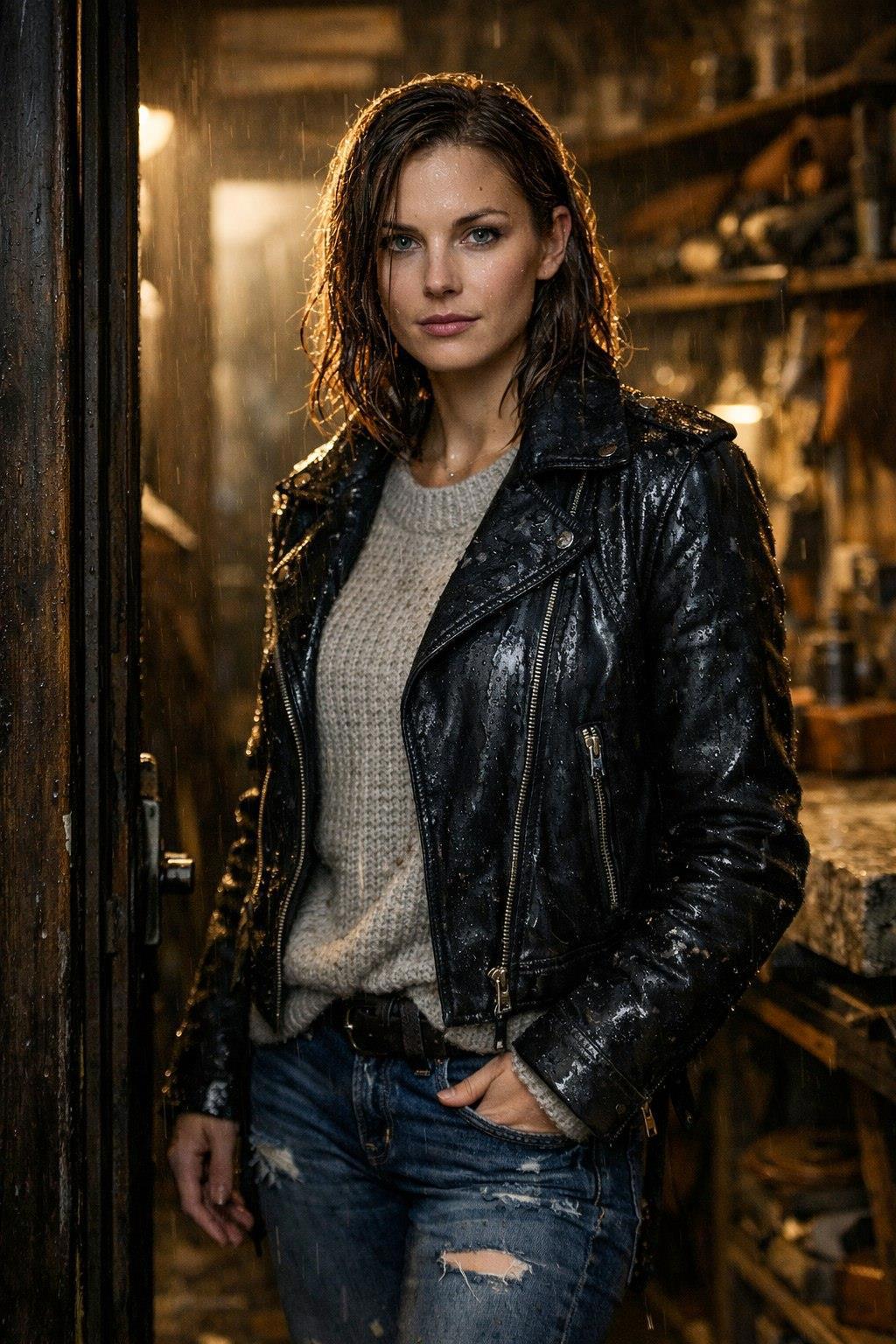
"Hello," she said. "Are you Yevgeny Zamyatin, the leather craftsman?"
"Yes," he answered, setting down his tool. "Who are you?"
"Anna Vetrova, journalist. I'm writing an article about old crafts. I was told you're one of the best in the city."
Yevgeny chuckled. One of the best. If she only knew how much debt he had and how often he'd been called a failure.
"Who told you?"
"Robert Davidovich, from the pharmacy. He praised you."
At the mention of the pharmacist, Yevgeny tensed.
"Praised me? Strange. He usually keeps quiet."
"He said you're talented," Anna came closer to the table, examining the wallets. "And that you're looking for something special."
"Looking," Yevgeny answered shortly. "Just haven't found it yet."
"What, exactly?"
He looked at her. In her grey-blue eyes was genuine interest, but also something else — a professional sharpness ingrained by habit. A journalist, then. One of those looking for sensations.
"The formula," he said, deciding truth was no worse than lies. "Perfect leather. Living leather."
"Living?" Anna repeated. "Leather can't be alive. It's a material."
"It can," he objected, and in his voice appeared that very obsession his mother so feared. "I feel it. It should respond to your hands, breathe, retain warmth. Like it was on a living being."
Anna looked at him intently. Then her gaze shifted to the bracelet on his wrist.
"Beautiful," she remarked. "Did you make it yourself?"
"Yes," he touched the silver Aquarius automatically. "My first successful piece."
"May I see?"
He extended his hand. Anna took it, turned the bracelet, examining the weave. Her fingers were cool, but the touch responded with warmth somewhere inside.
"Fine work," she said. "You truly are talented."
Yevgeny was embarrassed. No one had spoken such words to him for a long time, just like that, without haggling and discounts.
"Thank you," he muttered, looking away.
"May I look at your work?" Anna asked. "For the article. And maybe you'd agree to an interview?"
"What for?" he asked suspiciously.
"Because people should know about masters like you. You make things you can't buy in stores. It's art. And art needs attention."
Yevgeny was silent. Then nodded toward the shelves.
"Look."
She walked around the workshop, picked up wallets, bags, belts, examined the stitching, felt the leather, sometimes held it up to the light. And as she looked, her face changed. Professional wariness gave way to genuine admiration.
"This is incredible," she breathed, examining the bag he'd made at the "harmony" stage. "It's like living. Warm."
"It's Italian leather," Yevgeny explained. "The best available. But still..." he trailed off.
"What?"
"It's not right. Something's missing. Soul, I guess."
Anna looked at him for a long time.
"You're strange, Yevgeny. But I think you're right. There's soul in your work. Yours."
He didn't know what to answer.
"Let me record an interview," she suggested, taking out a recorder. "Tell me about yourself, your path. How you came to leatherwork."
"Long story," he warned.
"I have time."
And he told her. Briefly at first, then got carried away, then couldn't stop. About his first steps, disappointments, loans, his mother, his search for the ideal. Anna listened without interrupting, only occasionally asking questions. And when he finished, it was dark outside.
"Thank you," she said, turning off the recorder. "That was honest."
"Won't you write about the debts?" he asked with a crooked smile.
"No," she promised. "I'll write about a master. About a man searching for perfection. That's more important."
She prepared to leave, but at the door turned.
"May I come again? To watch you work. I need process photos for the article."
"Come," he allowed.
And felt that he wanted her to.
Chapter 3. Investigation
Anna came three days later.
Yevgeny was working on another wallet — for a gallery that had invited him to participate in a craftsmen's exhibition. His hands moved confidently, the stitch lay even, but in his head still itched: "not right, not right, not right."
"Hello," came from the door.
He looked up. Anna stood on the threshold, shaking drops from her jacket. Today she wore jeans and a warm sweater, her hair pulled back. Simple, yet somehow cozy.
"Come in," he nodded. "I'm working."
She approached, stood to the side, watching. He felt her gaze on his hands, and it was strange — both distracting and pleasantly exciting.
"May I photograph?" she asked, taking out a camera.
"Go ahead."
Clicks of the camera accompanied his work. Anna shot his hands, tools, leather, the finished wallet. Occasionally she asked questions: "Why did you choose this stitch?" "What does this treatment mean?" He answered, and gradually the tension eased.
"And what's that?" she asked, pointing to the granite slab in the corner.
"A slab. For polishing. Thought it would help."
"Did it?"
"No," he chuckled. "Just broke the floor. But can't bear to throw it away. A monument to myself."
Anna approached, ran her hand over the smooth surface.
"Beautiful. Cold. Like a tombstone."
"Exactly," he agreed. "A tombstone for my hopes."
She looked at him, and something warm flickered in her gaze.
"Don't say that. You'll still make what you've dreamed of."
"You believe that?"
"Yes," she answered simply.
That day they talked until evening. Anna told him about her work, how hard it was to be a journalist when you want to write the truth but the editor only wants clickbait headlines. Yevgeny listened, surprised at how easy it was to talk to her. She didn't laugh at him, didn't advise him to "get a real job." She was just there.
Before leaving, she asked:
"You said you're looking for a formula. Something like perfect leather?"
"Yes."
"And how do you know it exists?"
Yevgeny thought.
"I don't. But if you don't believe it exists, what's the point of all this?"
Anna nodded, as if she understood something important.
"I'll come again tomorrow," she said. "If that's okay."
"It's okay," he replied.
And for the first time in a long while, he fell asleep with a smile.
Chapter 4. The Pharmacist
The next day, Anna didn't come.
Yevgeny waited until evening, glanced out the window several times, but the street was empty. He was angry at himself for waiting, and couldn't stop.
Anna, meanwhile, sat in the old pharmacy, listening to Robert Davidovich.
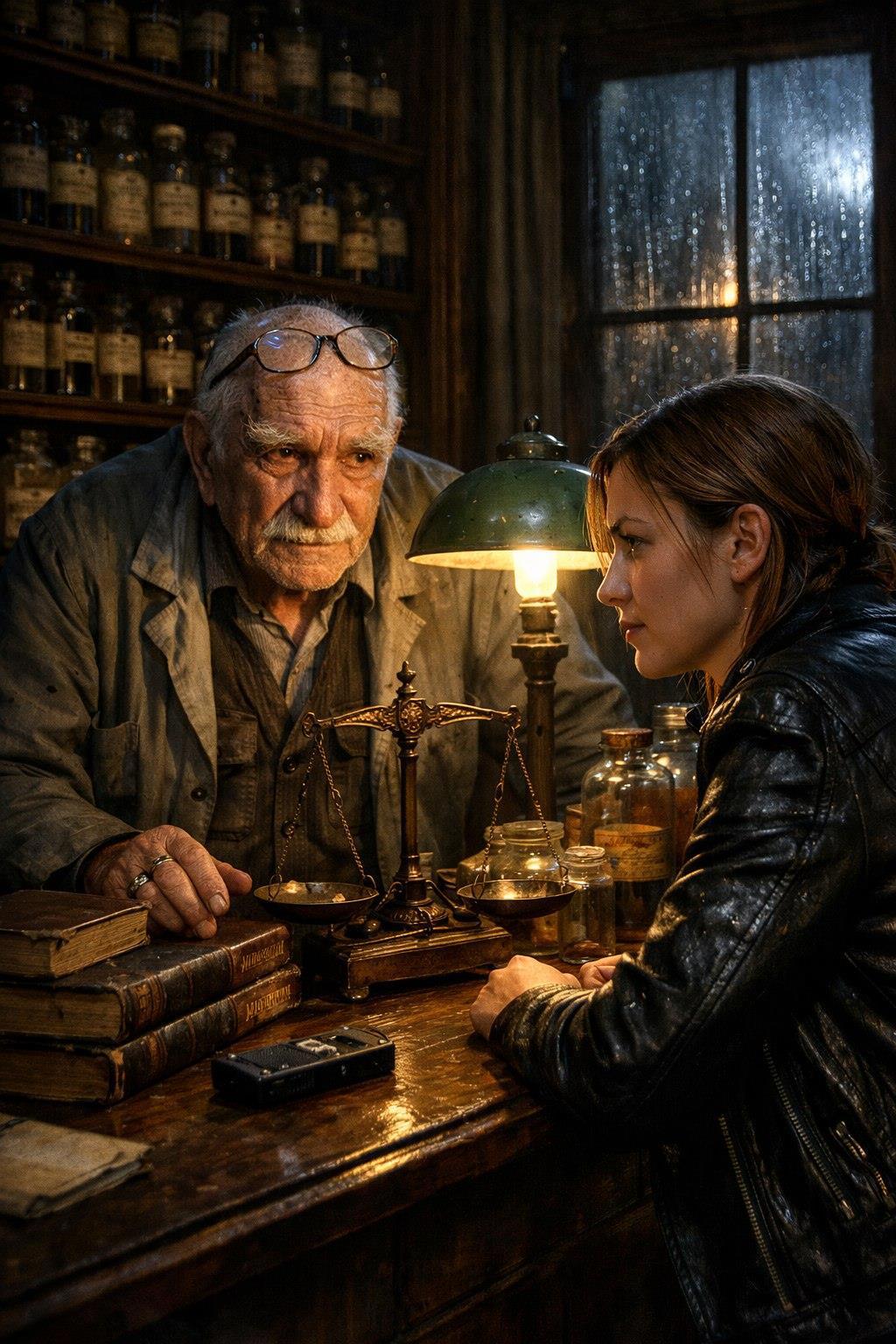
"You're writing about him?" the old man pushed his glasses onto his forehead, studying her. "Why?"
"He's an interesting person. Talented. I want people to know about him."
"Talented," the pharmacist repeated. "Yes. And dangerous."
"Dangerous?" Anna tensed.
"Listen, dear," Robert Davidovich sighed, setting down a jar. "I've worked here fifty years. I've seen many. But Zhenya... he's not just looking for a craft. He's looking for a soul. In leather. You understand?"
"I understand. He said so."
"He said," the old man chuckled. "And do you know what happens when you search too long for a soul in dead things?"
Anna was silent.
"You start looking for it in living things," the pharmacist finished. "Have you heard the legend about the old tanner?"
"No."
And Robert Davidovich told her. About the master who made leather like living. About how he used human material. About how his workshop burned down with him.
"Do you believe it?" Anna asked when he finished.
"I'm an old man," the pharmacist answered evasively. "I don't believe many things, but I've witnessed many. One thing I'll say: when a person searches too long for perfection, he stops noticing boundaries. He thinks everything is permitted. As long as the formula is found."
He looked directly at Anna.
"Watch him closely, girl. He's good, but sick. Sick with his dream. Such people can do terrible things. And you're close. If you sense something — leave. Don't try to save him. Don't get involved. Understand?"
Anna nodded, but in her heart she already knew she wouldn't obey.
"Thank you, Robert Davidovich."
"Don't mention it. Go."
She left the pharmacy, and the cold wind hit her face. Words swirled in her head: "human material," "living leather," "the formula." She looked toward Yevgeny's workshop. The light was on.
Chapter 5. Closeness
"Why are you so wet?" Yevgeny opened the door and stared at her in surprise. "Come in quick, you'll catch cold."
She entered, shaking herself off.
"Rain. I don't have an umbrella."
"Sit by the stove," he pointed to the old potbelly stove he heated for warmth. "Want tea?"
"Yes."
They sat, drank tea, were silent. Anna watched him stir sugar, his thin fingers holding the cup. And suddenly asked:
"Do you believe the legend? About the tanner who used people?"
Yevgeny froze.
"You went to the pharmacist?"
"Yes."
"And what did he tell you?"
"Everything."
He chuckled, set down his cup.
"Nonsense. Fairy tales for tourists."
"What if it's not?" she asked quietly. "What if you really could make leather that's alive?"
He looked at her for a long time.
"You can," he said suddenly. "I almost did. But something was missing. The most important thing."
"What?"
"Life," he answered simply. "The leather has to come from a living being. Not from dead material, but from something that had life. Then it would breathe."
Anna felt a chill run down her spine.
"You haven't thought..." she began and stopped.
"Haven't thought," he interrupted. "And I don't think. That's madness. I'm not a murderer."
"I know," she said quickly. "Sorry."
They fell silent again. Rain rustled outside, logs crackled in the stove.
"Thank you for coming," Yevgeny said quietly. "I'm good with you."
"Me too," she answered.
And in that moment, something changed between them. Something that could no longer be called just a journalistic investigation.
Chapter 6. Debts
A week flew by unnoticed.
Anna came almost every day. They drank tea, talked about leather, about life, about childhood. Yevgeny showed her his new works, she sincerely admired them. Sometimes she brought food because she knew he forgot to eat. Sometimes she just sat beside him while he worked, silent.
For the first time in years, he didn't feel alone.
But debts didn't wait.
The collector appeared on Thursday. Yevgeny was finishing a belt for Anna — he wanted to give her a gift. The knock at the door was sharp, impatient.
"Zamyatin! Open up!"
Yevgeny flinched, set down the belt. Went to open.
On the threshold stood a man around forty, short-haired, in a leather jacket, with a gold chain around his neck. Behind him loomed another, younger, muscular, with a dull gaze.
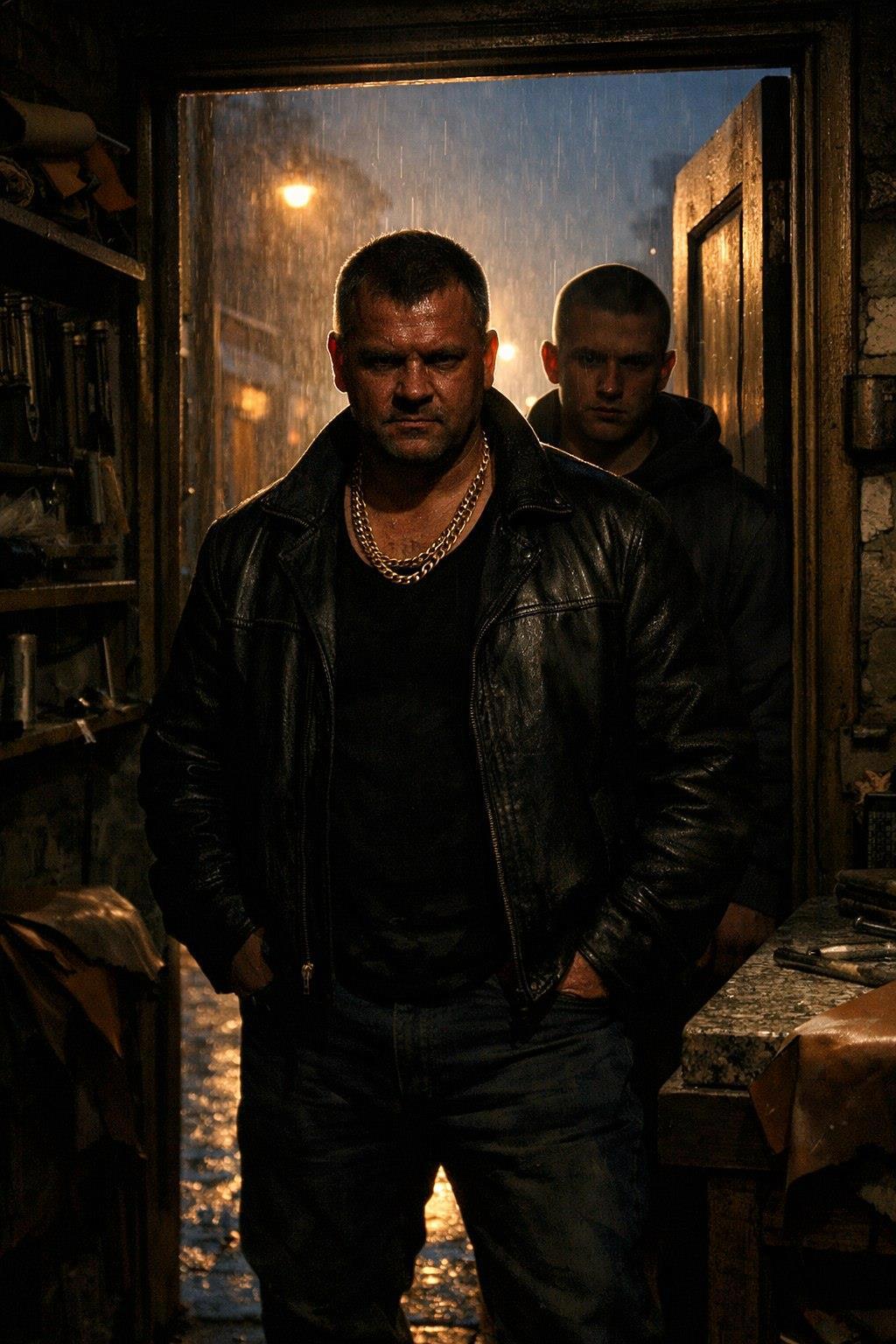
"You Zamyatin?"
"Yes."
"Time to pay your debt," the collector stepped inside without invitation. "Three months overdue. Got money?"
"Not now. I will, soon..."
"Soon doesn't cut it," the man scanned the workshop with a practiced eye. "Oh, nice stuff. Sell something — and pay up."
"It's not for sale," burst from Yevgeny. "These are tools, materials..."
"I don't care," the collector smirked. "I'll be back in a week. If there's no money — I'll start taking goods. And if you resist — I'll burn this flophouse down. Got it?"
"Got it."
"And remember," the collector stepped closer, lowering his voice. "I know your mom. She lives alone, right? If you don't pay — I'll visit her. Got it?"
Yevgeny went pale.
"Got it," he forced out.
The man slammed the door so hard a shelf of punches fell from the wall.
Yevgeny stood, staring at the scattered tools. His hands shook.
That evening, Anna came. She saw his face, understood.
"What happened?"
"Collector," he answered hollowly. "Demands the debt. A week."
"How much?"
"Two hundred thousand. With interest."
She whistled. Sat beside him, took his hand.
"Zhenya, we need to do something. Sell something..."
"Nothing to sell. Everything of value is already sold. Or pawned."
She looked at his hands. Beautiful master's hands. And suddenly she was struck with an idea.
"What about a commission? A real commission? If someone would pay what your work is worth?"
"Where would you find someone like that?"
"I don't know," she answered honestly. "But I'll try. I'm a journalist, I have connections. I'll write an article, show your work. Maybe someone will respond."
He looked at her. Hope flickered in his eyes, but died immediately.
"It won't help. I've tried. Nobody wants it."
"If you don't try — it definitely won't help," she said firmly. "Come on, show me your best pieces. I'll photograph them. I'll start writing tomorrow."
That evening, they spread on the table everything he'd made over the years. Wallets, bags, belts, document covers. Anna clicked her camera, asked about each piece, took notes. Yevgeny talked, and gradually the fear receded.
"You know," he said when they finished, "you're the first person who's responded like this. To my work. To me."
"I'm not the first," she smiled. "I'm just the one who saw."
He took her hand, brought it to his lips, kissed it. Simply, without words. She froze, then slowly withdrew her fingers.
"Zhenya, I..." she began.
"Don't speak," he asked. "No words needed. Just stay a while longer."
She stayed. Till morning they sat side by side, silent, listening to the wind howling outside. And in the morning she left — to write an article, to save him.
Chapter 7. Murder
The week flew by like a day.
The article was published, read by several thousand people. A few wrote saying they'd like to order something. But the orders were small, the money meager. The debt hung over him like the sword of Damocles.
On the appointed day, Yevgeny sat in the workshop waiting. His hands shook; he couldn't work. Just sat and stared at the door.
His mother had gone to the store. He'd asked her not to go, but she waved it off: "I can't stay cooped up forever because of some thug."
He heard steps on the stairs. Not one, two. His heart sank.
The door burst open without a knock.
The collector wasn't alone. With him was the young, muscular one.
"Well, debtor," the collector grinned. "Ready to pay?"
"No money," Yevgeny forced out. "But I'll have some. Soon..."
"You've been singing that song for a month," the collector interrupted. "Fine, if you won't be nice — we'll do it the hard way. Search the place. Everything valuable — we take."
The young one stepped to the shelves, began scooping tools into a bag. Yevgeny rushed at him:
"Don't touch that! It's not for sale!"
"Get back," the collector shoved him.
"They're tools! I can't work without them! Then I'll never pay the debt!"
"I don't care," the collector hit him in the chest; Yevgeny flew against the wall, hitting his head. "You owe me money. How you earn it — your problem."
At that moment, the door opened. His mother entered.
"Zhenya? What's going on..."
"Mom, go away!" Yevgeny screamed.
But the collector had already turned to her, looked her up and down.
"Oh, mom's here. Old, but not bad. Listen, mom, tell your son to pay his debt. Or else something might happen to you."
He stepped toward her, flexed his jaw. His mother went white, pressed against the doorframe.
"Don't touch her!" Yevgeny lunged, but the young one caught him, pinned him to the wall.
"Or what?" the collector smirked. "Gonna take me on? Little punk."
He reached out, took the mother by the chin, turned her face toward him.
"Don't worry, granny, you're still spry. Maybe you can work off the debt?"
Something snapped in Yevgeny's head.
He wrenched free from the young one's grip, grabbed the first thing at hand — a heavy cast-iron hardware press. And struck.
The blow caught the collector in the temple. He grunted, released the mother, staggered back, tripped on the edge of the granite slab and fell.
His head hit the stone with a dull, terrible sound. Like a watermelon. The collector twitched once, twice, and went still.
The young one froze, let go of Yevgeny, stared at the fallen man.
"You... you killed him..." he stammered. "You..."
"Get out!" Yevgeny roared. "Get out before I..."
The young one bolted out the door, thundering like an elephant.
Silence fell.
His mother stood pressed against the doorframe, staring at the body with wide eyes. Her lips trembled.
"Zhenya..." she whispered. "Zhenya, is he... is he dead?"
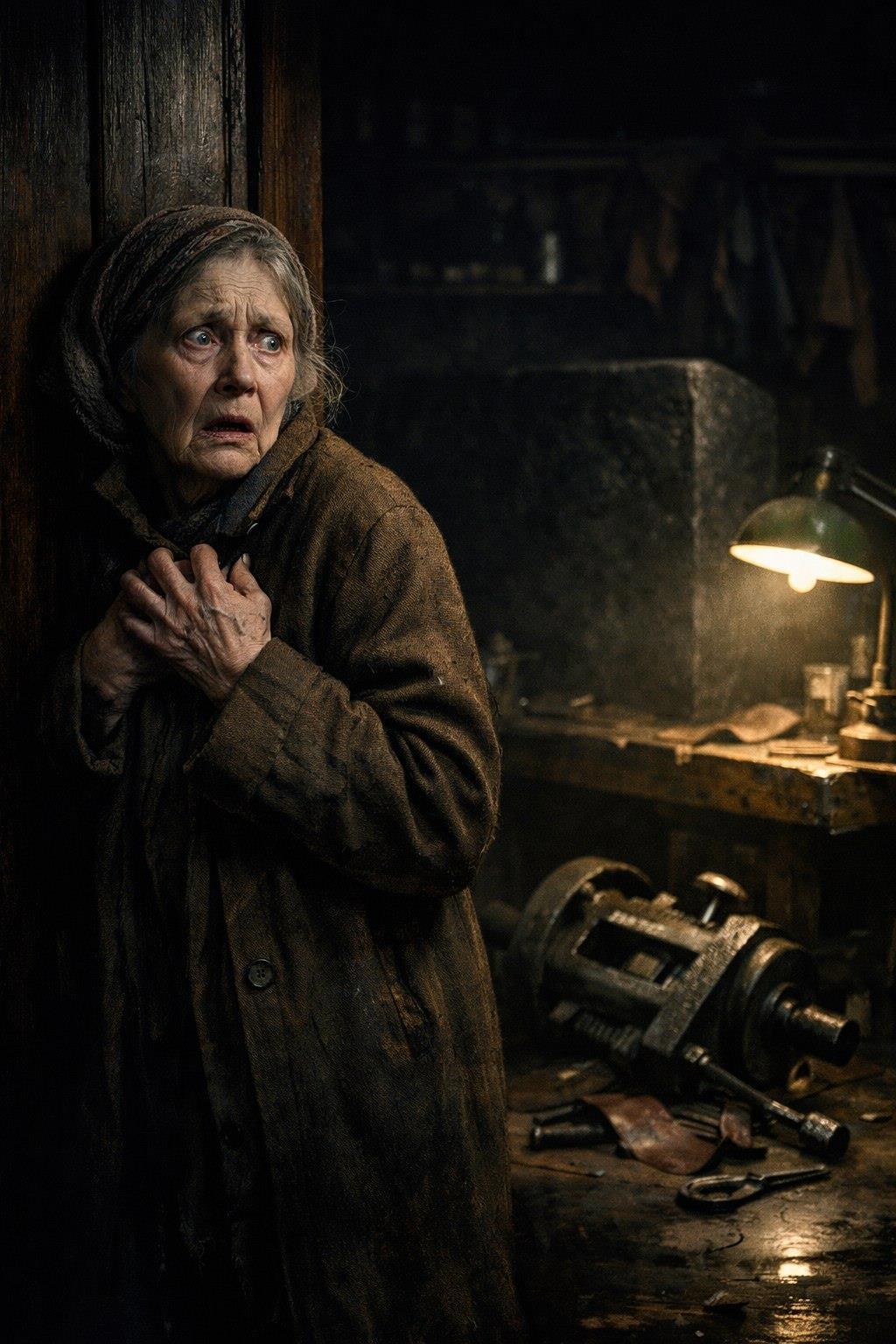
Yevgeny approached, bent down. Felt the neck. No pulse.
"Dead," he said in a stranger's voice.
His mother slid down the wall to the floor. Cried silently, shaking all over.
"What now?... What'll happen now?... Zhenya..."
"I don't know," he answered. "I don't know."
He stood over the body and stared. His head was empty. Only one thought beat like a fly against glass: "Killed. I killed a man."
And then his gaze fell on the dead man's skin. On his arm thrown to the side, where the jacket had ridden up, revealing a strip of flesh. The skin was smooth, clean, flawless. Almost perfect.
And suddenly the pharmacist's words surfaced: "He used another material. Human."
Yevgeny shuddered, recoiled.
"No," he whispered. "No, don't you dare."
But the thought had already lodged. And it wouldn't leave.
Chapter 8. Masterpiece
He didn't remember how he persuaded his mother to go to the neighbors. How he moved the body to the corner, covered it with an old tarp. How he sat staring at the grey bundle while it grew dark outside.
Fragments raced through his head: call the police, turn himself in, run, hide... But no thought stuck. Because alongside them was another. Terrible. Forbidden.
Skin.
He stood, approached, lifted the tarp. The dead man's face was calm, eyes closed. A livid bruise on his temple, but the skin intact. And on his hands, his neck, his back... everywhere the skin was clean, smooth, youthful. Almost perfect.
Yevgeny stared and couldn't look away. His hands reached out by themselves, touched the wrist. Cold, but not yet stiff. The skin was firm, warm to the touch. Alive.
It was alive so recently.
He jerked his hand back, recoiled. Covered his face with his palms. Breathed rapidly, like a hunted animal.
"Don't you dare," he whispered. "Don't you dare, it's madness, it's a sin, it's..."
But before his eyes stood that perfect bag he'd made. Dead. Beautiful, but dead. And this skin... it was alive. Even now, after death, it retained warmth, elasticity, life.
If I take it, tan it properly, add that harmony... I'll make something priceless.
He groaned, clutched his head. His temples throbbed, thoughts tangled. Somewhere inside, the voice of reason screamed: "He's a human! It's murder! You have no right!" But another voice, quiet, insinuating, whispered: "What is a human after death? Just meat. Just material. You didn't kill him for his skin. He came himself. Asked for it. It was an accident. And the skin... the skin will go to waste. Rot in the ground. But it could become a masterpiece."
He didn't remember taking the knife.
That very Japanese leather knife, bought for insane money. Sharper than a razor. He looked at the blade, at his reflection in the metal, and didn't recognize himself. His eyes were alien — dark, deep, mad.
"Forgive me," he whispered. "Forgive me, but... but I have no choice."
He turned the body onto its stomach. The tarp rustled unpleasantly. His hands trembled, but when he touched the skin, the trembling stopped. His fingers found the right place by themselves — on the back, where the skin was cleanest, smoothest, the largest area.
The knife entered easily. Very easily. Like butter.
For three days, he didn't sleep.
His mother called, knocked; he didn't open. Anna wrote; he didn't answer. The world ceased to exist. Only the skin. That which lay on the table, treated, soaked in special solutions, cleaned of everything superfluous.
It didn't behave like ordinary leather. It was obedient. It obeyed his hands, as if it knew what he wanted. It took the shape he gave it without resistance. It smelled... of life. Not chemicals, not tanning agents, but something warm, real.
Yevgeny worked as if in a trance. Tools fell into his hands by themselves, stitches laid perfectly, edges curled evenly. Not a single mistake, not a single unnecessary movement. For the first time in his life, he felt not like a craftsman, but a creator. Not a master, but a demiurge.
On the third night, the wallet was finished.
Small, elegant, palm-sized. Leather — softer than silk, stronger than steel. Color — warm, honeyed, with a slight pearlescent sheen. Stitches — perfect, even, like strings. On the front, an embossing: Aquarius, his sign. The same as on his bracelet.
Yevgeny held it in his hands and couldn't stop admiring it.
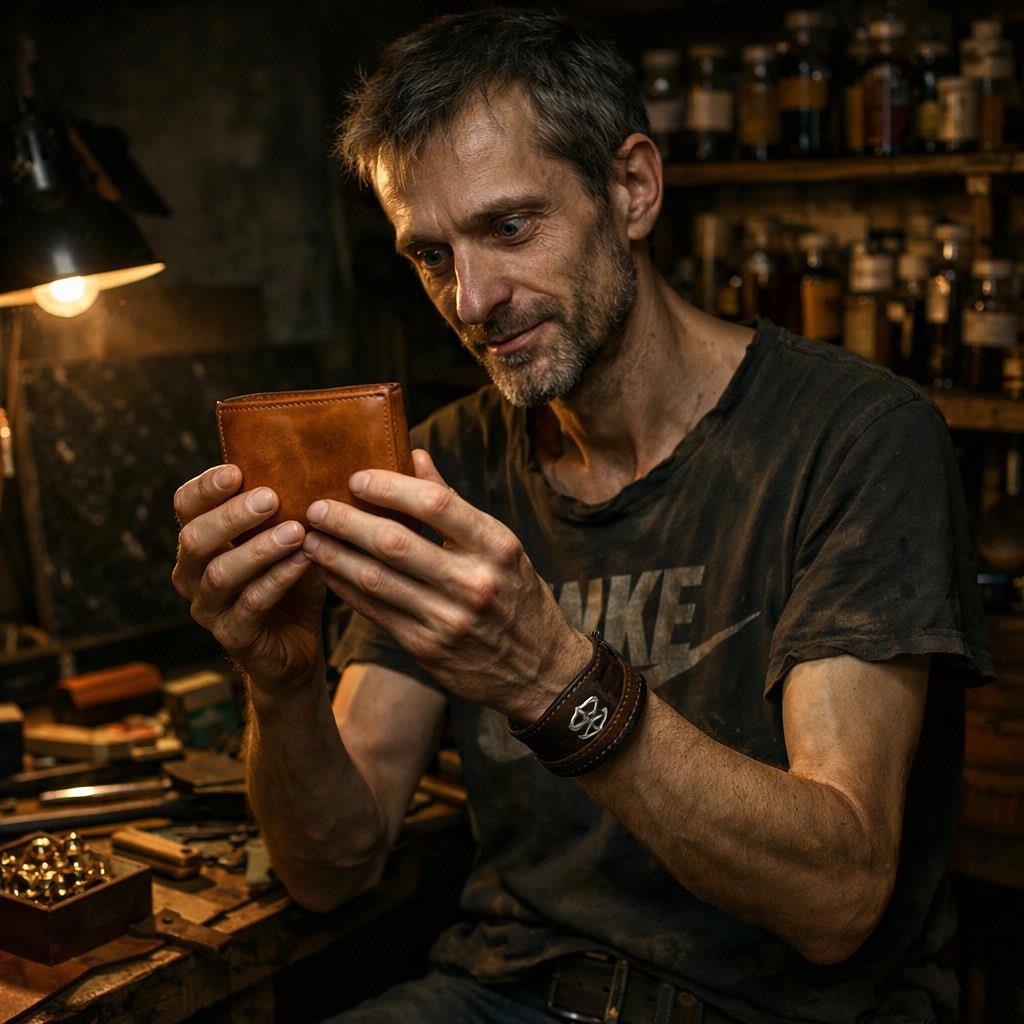
"Beautiful," he whispered. "The most beautiful."
He brought it to his face, inhaled. The leather smelled... of nothing special. Just leather. But somewhere deep, at a subconscious level, there was a faint, barely perceptible undertone. The one he'd been seeking all his life.
"There it is," he said. "The formula. There it is."
He laughed. Softly, then louder, then hysterically, choking with laughter. The laughter turned to sobs. He fell to his knees, pressing the wallet to his chest, and cried, and laughed, and couldn't stop.
In the morning, Anna knocked at the door.
Chapter 9. The Truth
"Zhenya! Open up!" she had been pounding on the door for ten minutes. "Zhenya, are you there? Are you okay?"
Finally, the lock clicked. The door opened a crack. On the threshold stood Yevgeny — unshaven, red-eyed, gaunt, but with a strange, blissful expression.
"Oh, it's you," he said matter-of-factly. "Come in."
She entered and froze.
The workshop had changed. It was clean, tools arranged in their places, jars put away. On the table, on a white cloth, lay a small wallet. It glowed in the morning light, shimmering with a warm honeyed hue.
"What's that?" Anna asked, approaching.
"Look," Yevgeny took the wallet, handed it to her. "This is the best thing I've ever made. An absolute masterpiece."
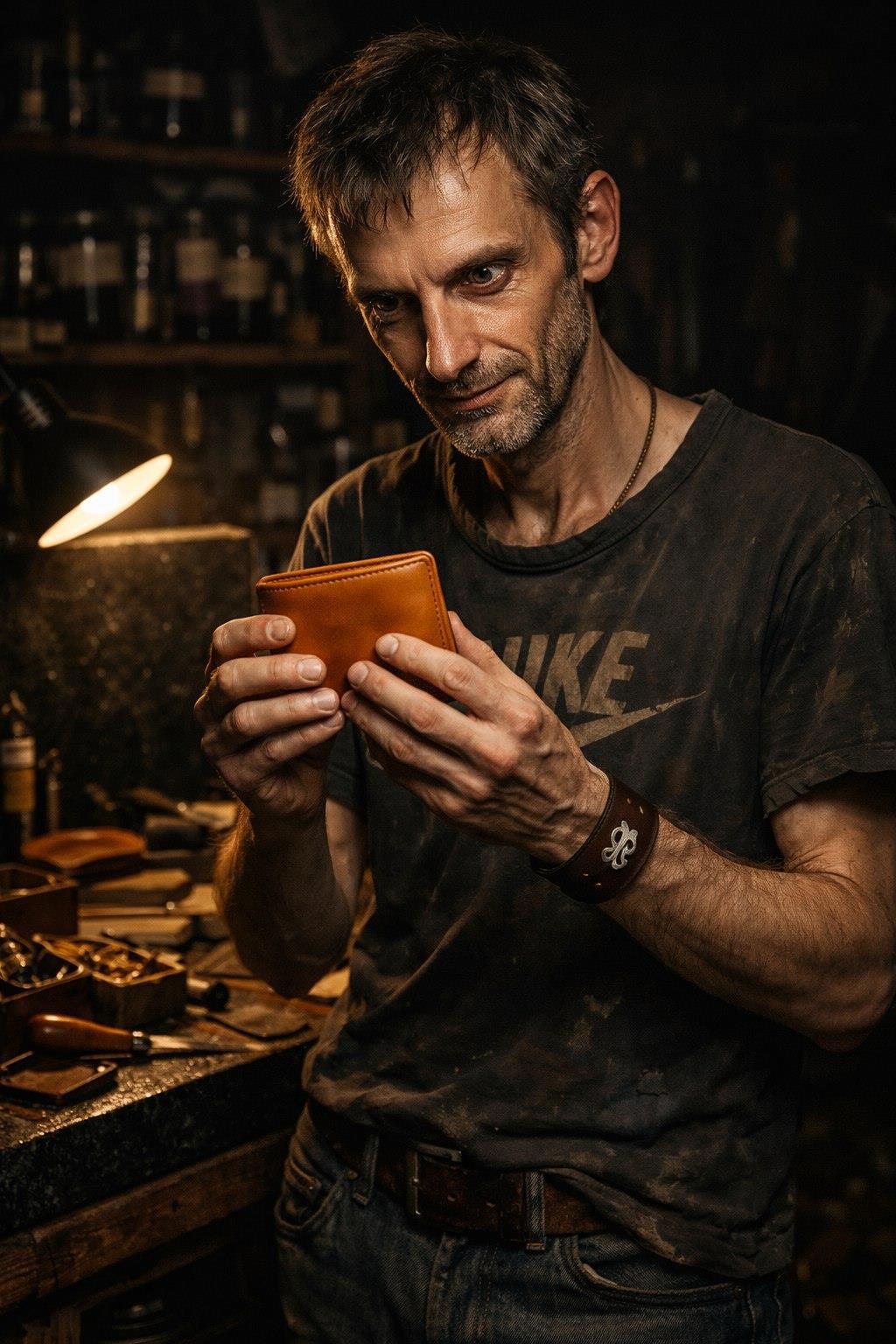
She took it in her hands. The leather was incredible — soft, warm, almost alive to the touch. Perfect stitching, delicate embossing. A piece you couldn't tear your eyes from.
"Beautiful," she breathed. "Very. What kind of leather?"
"Special," Yevgeny smiled. "Unique. I searched a long time. And finally found it."
Anna looked at the wallet, and suddenly something pricked inside. A vague unease. She brought it to her face, inhaled. The leather smelled... ordinary. But somewhere deep, barely perceptibly, there was an undertone she couldn't identify. Something familiar. Something...
"Where did it come from, Zhenya?" she asked, trying to keep her voice steady.
"Found it," he repeated. "A supplier. Exclusive material."
"What supplier?" she no longer hid her alarm. "Where?"
Yevgeny was silent. Looked at her with that same blissful smile. And suddenly Anna understood.
She remembered the pharmacist. "Human material." Remembered the collector who'd come. Remembered that Yevgeny had been out of contact for three days.
"No," she whispered. "No, Zhenya, don't tell me..."
"What?" he asked, and his smile widened. "What did I do? I did what I had to. I found the formula. Look at this leather! Have you ever seen such? It's alive! You understand? Alive!"
Anna recoiled, dropped the wallet. It fell to the floor softly, almost silently.
"Where... where's the body?" she forced out.
"Disposed of," Yevgeny answered simply. "Took it out at night. No one will find it."
"You killed a man!" she screamed. "You're insane! You..."
"I didn't kill him," he interrupted, and for the first time, hurt flickered in his voice. "He fell himself. I just hit him, and he fell and hit his head. On the slab. Remember the granite slab? It killed him, not me. And the skin... the skin would have gone to waste. You understand? Gone to waste! And I made this from it. A masterpiece."
Anna looked at him and saw before her not the man she'd drunk tea with, whom she'd let kiss her hand. Before her stood a stranger. A madman. A monster in a master's skin.
"I have to go," she said, backing toward the door. "I have to..."
"Anna," he stepped toward her. "Don't go. Look again. Touch it. It's a miracle!"
"Don't come near me!" she screamed. "Don't come near me!"
She rushed out the door, ran down the stairs, burst into the street. Cold air hit her face, but inside everything burned. She shook, felt sick, wanted to scream.
She reached the corner, stopped, leaned against a wall. And vomited.
And in the workshop, on the floor, lay the small wallet made of human skin. A masterpiece that cost a life.
Chapter 10. Arrest
The police arrived two hours later.
Anna called from a city payphone, with trembling fingers dialing 02. She spoke incoherently, but got the main point across: murder, a tanner's workshop, evidence.
When the officers burst into the workshop, Yevgeny sat at the table drinking tea. Beside him lay the wallet — he'd picked it up from the floor and placed it in plain sight. As if he'd been waiting.
"Zamyatin, Yevgeny?" asked the captain.
"Yes," he replied calmly. "Come in. Want some tea?"
"You're under arrest on suspicion of murder."
"I know," he nodded. "I was waiting."
He stood, extended his hands for the handcuffs. And suddenly said:
"Just take the wallet. It's the main evidence. And a masterpiece. You understand, such things can't be lost."

The captain exchanged glances with the officers. Then nodded, and the wallet was bagged.
Yevgeny was led away. At the door, he turned, looked at the workshop. At the granite slab, the shelves of tools, the jars of chemicals. Everything remained here. Everything he'd devoted his life to.
"Too bad," he sighed. "Didn't finish the bag. The last one. It would've been good too."
"Let's go," the guard prodded him.
And the door slammed shut.
Epilogue
Anna walked out of the detention center.
Her legs wouldn't obey; she walked like a somnambulist. In her jacket pocket lay the wallet. Small, elegant, made of the softest leather. Yevgeny had slipped it into her hand at parting, when the guard turned away.
"Keep it," he whispered. "It's the best thing I ever made. Let it be with you. You'll understand."
She hadn't wanted to take it. But her hand closed by itself, and the wallet vanished into her pocket.
Now it warmed her side through the fabric. Or so it seemed?
She walked down the street, not watching where she was going. The evening city lived its life: people hurried, cars rushed by, shop windows glowed. For them, nothing had changed. For her, everything had.
Suddenly she looked up and froze.
A shop window. A leather goods store. Expensive bags, briefcases, belts, wallets — neatly arranged on shelves, softly lit. Perfect stitching, noble texture, pleasant colors.
Anna stared at them, and the world around ceased to exist.
She didn't see bags. She saw skin. Lots of skin. Different kinds. And every item seemed to her a piece of something living that had once breathed, felt, feared. Stitches like scars. Shapes like parts of bodies.
Nausea rose in her stomach. First slight, then stronger. She was hot, then cold. She grabbed a lamppost to keep from falling. People passed by, not noticing her. For them, it was just a window display. For her, a mass grave.
"Don't..." she whispered. "Don't..."
But the window looked at her with dozens of leather eyes.
She retched onto the sidewalk. No vomit, just a dry spasm that squeezed everything inside. She doubled over, coughed, couldn't breathe. Pedestrians stepped around her; someone glanced disgustedly.
When the spasm passed, Anna straightened. She looked at her hands clutching the lamppost. On them was her skin. Living, warm, her own. But now it seemed alien.
Slowly, as if in a dream, she unzipped her biker jacket. The leather jacket that had been her armor, her second skin for so many years. She slipped it off her shoulders. In her hands, it became heavy, like a dead body.
Anna approached the shop window and carefully, almost reverently, laid the jacket on the ledge in front of the glass. Spread it out so it wouldn't fall. As if leaving a part of herself here.
Then she turned and walked away.
Her phone vibrated in her pocket. She took it out, looked. A notification from the Telegram channel "Leather Brotherhood." A post from the administrator, Rodion Mustafa Abu Jafar:
"Friends, today I want us to remember a master. Zhenya Zamyatin from our city. Many of you know him from his posts, his questions, the obsession with which he sought his ideal. He made mistakes, fell, got up, made mistakes again. But he searched. Sought the formula of perfection. It's not for us to judge where his search led him. But we can remember: he was one of us. A master. A man who loved leather more than life. May the earth be light for him, and the leather he created — eternal. Peace to his soul, Zhenya."
Anna stopped. Read it again. Then put the phone back in her pocket, next to the wallet.
And walked on into the grey murk of the evening city, without a jacket, without protection. Rain soaked her sweater, hair plastered her face. She didn't feel the cold. In her jeans pocket, pressed against her thigh, lay a small wallet made of human skin — the only evidence, the only memory, the only thing left of a man who had found his formula.
She walked into nowhere. Into a new life where there would be no more leather things. Or no life at all.
And the shop window still glowed, and on it lay the jacket — warm, still holding the scent of her body. Waiting for someone to take it.
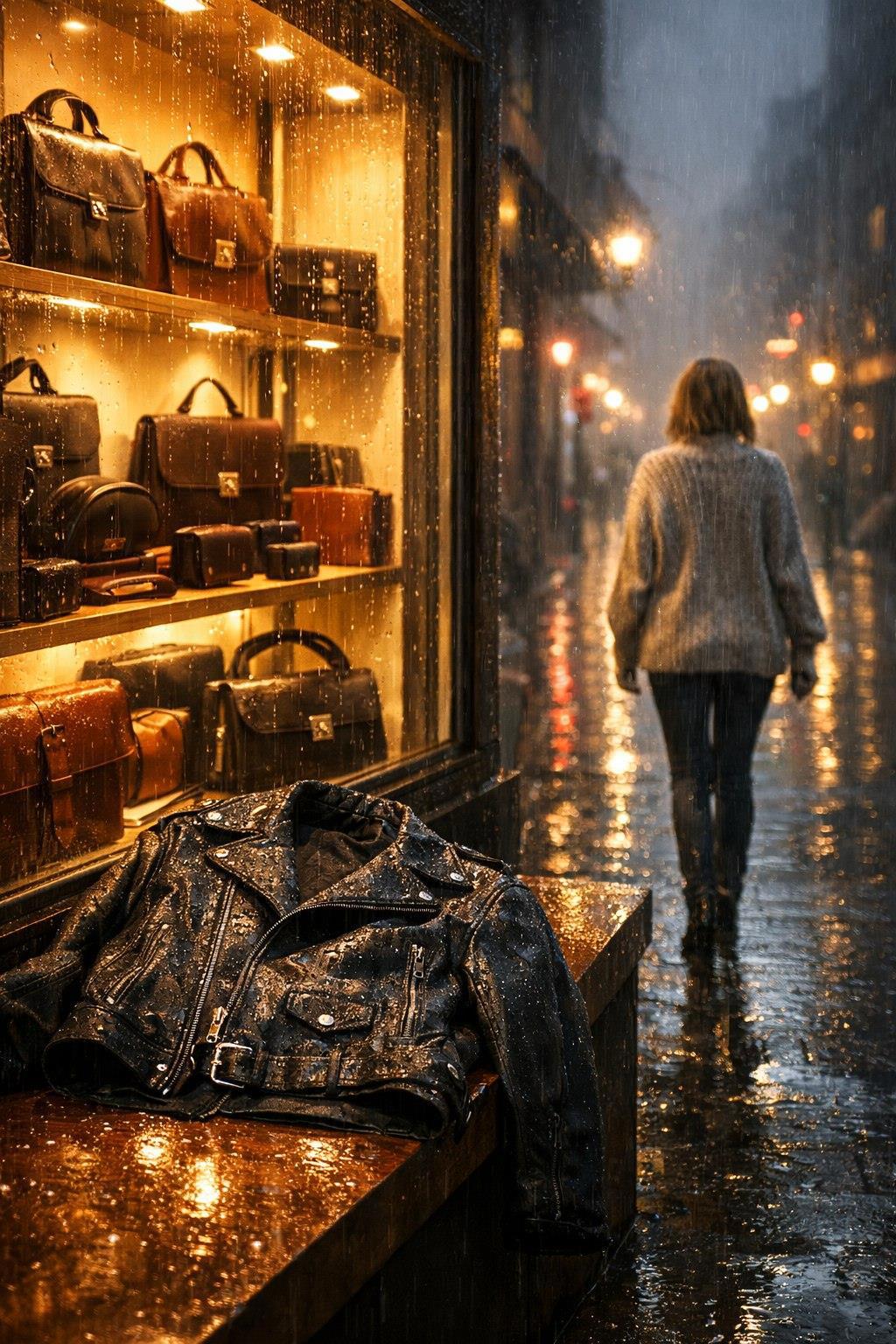
Like all things in this world.
In the Telegram chat, someone was already lighting a candle emoji, someone wrote words of support, someone just kept silent. The community lived its life. And somewhere in Moldova, Rodion Mustafa Abu Jafar looked at the screen and thought that even the darkest stories leave light, if there was soul in them.
The End.
The story was written by the author under the pseudonym Seraphim on March 1, 2026.
https://author.today/u/serafim30
Telegram username @Seraflm
 ТЕЛЕГРАМ
Канал с обзорами, анонсами новинок и книжными подборками
 Книжный Вестник
Бот для удобного поиска книг (если не нашлось на сайте)
 Поиск книг
Свежие любовные романы в удобных форматах
 Любовные романы
Детективы и триллеры, все новинки
 Детективы
Фантастика и фэнтези, все новинки
 Фантастика
Отборные классические книги
 Классика
 ВКОНТАКТЕ
Библиотека с любовными романами, которая наверняка придётся по вкусу женской части аудитории
Любовные романы
Библиотека с фантастикой и фэнтези, а также смежных жанров
Фантастика
Самые популярные книги в формате фб2
Топ фб2
книги